
Block Three Mornings
A cardiologist's practical prescription for building your exercise week


It’s 5:15 AM and dark in Anchorage.
12 ounces of cool water trickles down my throat. Coffee ready for brewing on my return. My winter spike shoes are by the door. Blitz the Giant Schnauzer is wearing his reflective vest. I have 50 minutes before my first kid wakes up and the day becomes someone else’s.
This is how my week gets built. It starts by showing up. Full disclosure: it took my wife, Katie, almost 15 years to turn me into a morning-first exerciser. I was an evening runner, an after-work lifter, a guy who swore the evening was his time. She was right. The morning is when the day’s are won. I see this in my patients who transform their health: they all discover the same thing. The week doesn’t find room for exercise. You build the week around it.
On Sunday, I wrote about the three tiers of health investment: 90 minutes, 3 hours, 6 hours. That framework answers how much. Today I want to answer how the practical structure of a week is built that actually sticks.
I owe much of this thinking to Gordo Byrn, an endurance coach whose book Going Long shaped how I thought about training structure years ago. His updated work, From Lemon to Legend, distills something I’ve come to believe deeply: sustainable fitness isn’t about heroic workouts. It’s about a repeatable basic week that you can execute for years.
That’s what we’re building today: a basic week that can be repeated indefinitely.
Step 1: Block & schedule three mornings.
One of my patients from last winter, Mike, a 47-year-old petroleum engineer, father of two, 30+ pounds over his college weight told me he’d tried everything. Peloton for six weeks. A trainer for three months. A running program he quit after only 2.
Every program failed for the same reason. He was trying to fit exercise into the margins of an already full day. By 6 PM, your willpower is spent. Meetings run late. The kids need dinner. The couch wins.
We changed one thing for Mike: he moved exercise to before his day started. 5:30 AM, three days a week. Monday, Wednesday, Friday. Non-negotiable. Scheduled in his calendar like a patient appointment that cannot be canceled.
Within four months, his resting heart rate dropped 12 beats. His triglyceride-to-HDL ratio normalized. He told me the exercise was the easy part… the hard part was believing that a 5:30 AM start was possible.
It is for you also. And it gets easier after about 30 days.
Pick three days. Pick a time before the world has over scheduled you. Block it. Own it. Do it.
Step 2: Pick something you’ll actually do.
This is not the time to start a program you hate. If you loathe running, don’t run. Get a stationary bike or a rowing machine. If the idea of cardio makes you want to close this tab, grab a pair of dumbbells and find a basic circuit. The most important variable in exercise adherence is enjoyment.
Gordo’s framework in From Lemon to Legend makes this point well: start where you are, not where you think you should be. The goal in the first 90 days is consistency, not optimization. We’ll refine modality, intensity and structure later. First, build the habit.
Step 3: Structure your hours.
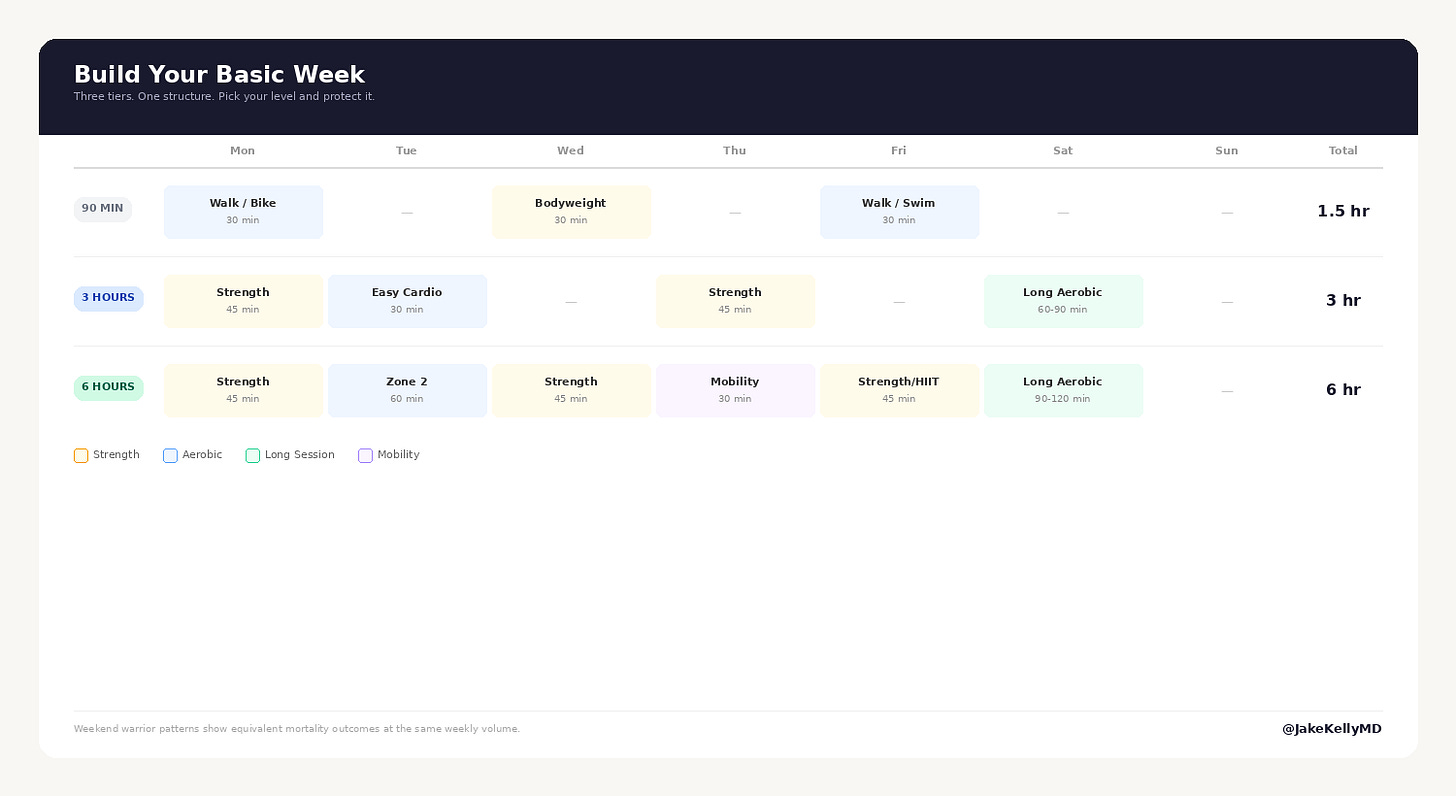
On Sunday I laid out the three tiers: 90 minutes, 3 hours, 6 hours per week. Here’s how those translate into an actual schedule.
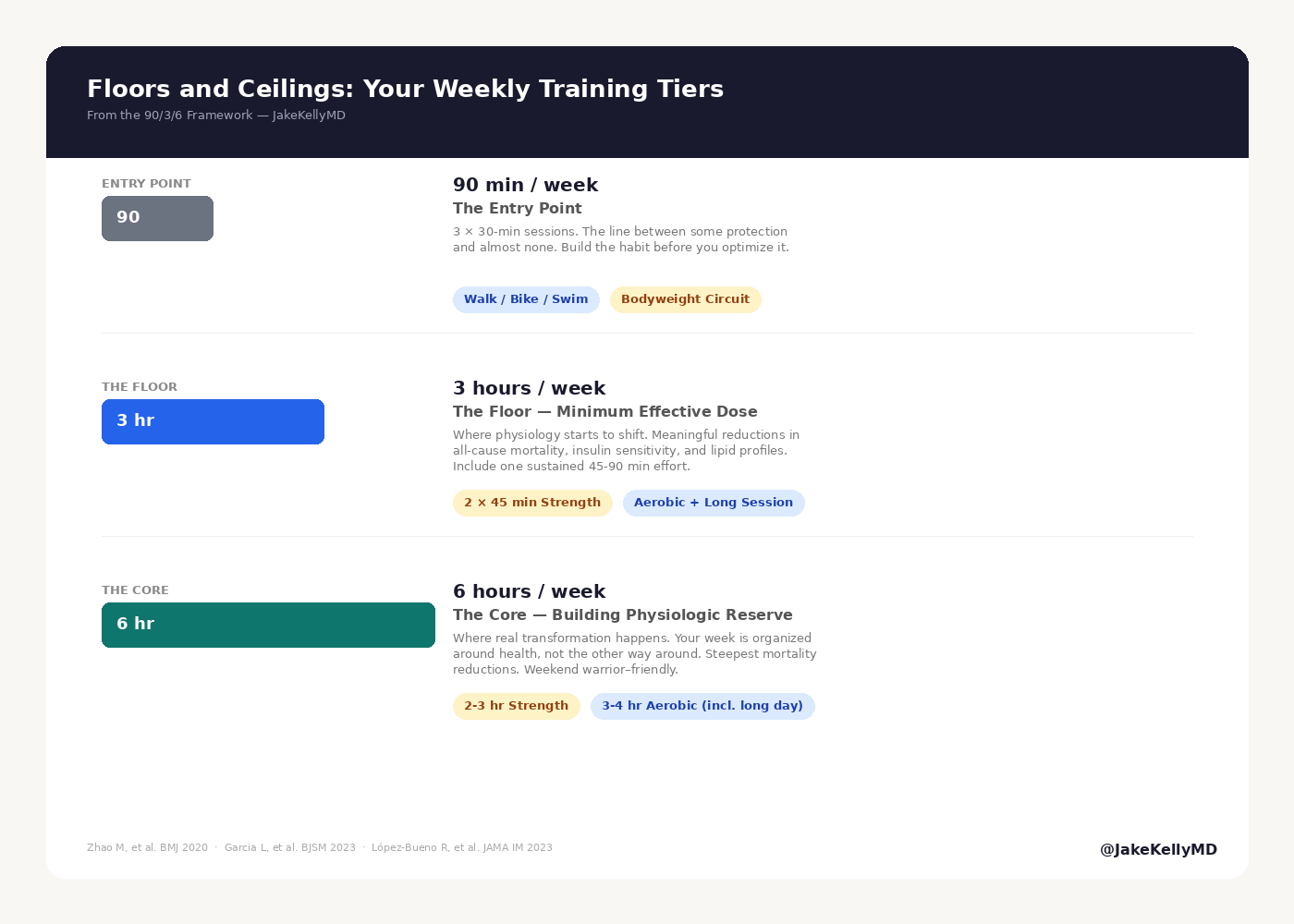
90 Minutes: The Entry Point
Three 30-minute sessions. Monday, Wednesday, Friday. This is where health begins to develop: the line between some protection and almost none. At this volume, the goal is habit, not optimization. Show up. Do something that raises your heart rate or challenges your muscles. This alone bends the mortality curve.
Hold this pattern for 4-6 weeks before adding anything.
Sample week:
Monday: 30-min walk or bike (moderate pace, conversational)
Wednesday: 30-min bodyweight circuit or dumbbells
Friday: 30-min walk, bike, or swim
3 Hours: The Floor
This is the minimum effective dose for real physiologic change. One hour three times per week, or 30 minutes daily. At this volume, the data shows meaningful reductions in all-cause and cardiovascular mortality, improvements in insulin sensitivity, blood pressure, and lipid profiles. Meeting the aerobic and muscle-strengthening guidelines simultaneously produces larger reductions in mortality than either alone.
On your weekend session, try to keep at least one unbroken 45-to-90-minute effort such as a long hike, a steady bike ride or an easy run. The sustained metabolic stimulus adds up.
Sample week:
Monday: 45-min strength (full body)
Tuesday: 30-min easy cardio (zone 1-2)
Thursday: 45-min strength (full body)
Saturday: 60-90 min continuous aerobic (hike, ride, run-walk)
6 Hours: The Core
This is where I see the most significant real-world transformation in my patients. Six sessions of 60 minutes, or a mix of longer and shorter days. A practical split: roughly 2-3 hours of strength training and 3-4 hours of aerobic work per week. At this volume, you’re building what I call physiologic reserve: capacity that stands between you and the health scare you didn’t see coming.
For compressed schedules, the weekend is your friend. Research on “weekend warrior” patterns shows no meaningful difference in mortality outcomes compared to evenly distributed training, as long as total weekly volume is comparable. My friend and mentor Dr. Adam DeVore, head of transplant cardiology at Duke, introduced this research paper to me during fellowship. As a dedicated cardiologist and father, he could only find time on Saturdays and Sundays, so he’d do back-to-back running workouts on the weekend (and stayed very fit). It impressed upon me that consistency in total volume matters more than perfect distribution. Three 30-to-60-minute sessions during the week, then one or two 90-minute to 2-hour activities on Saturday and Sunday such as a family hike, an early morning ride or a long run.
Sample week:
Monday: 45-min strength
Tuesday: 60-min aerobic (zone 2 focus)
Wednesday: 45-min strength
Thursday: 30-min easy movement or mobility
Friday: 45-min strength or intervals
Saturday: 90-120 min long aerobic (hike, ride, run)
Making It Stick
Building the basic week is a behavior change problem before it’s an exercise problem. James Clear’s Atomic Habits offers the most practical framework I’ve encountered: make the desired behavior obvious, attractive, easy, and satisfying. For exercise, this means removing every decision between the alarm and the door. Lay out your clothes the night before. Keep your shoes visible. Have your playlist or podcast ready.
The goal in the first 90 days is not fitness. The goal is showing up. There’s reasonable evidence that three days per week for approximately three months is sufficient to establish a durable habit. Give your basic week this long before you evaluate whether it’s working.
The Compound Effect
Mike, the petroleum engineer who thought 5:30 AM was impossible just completed his first year of consistent training. He’s lost 30 lbs. His LDL dropped 28 points. His wife started training with him three months in. More importantly, he has regained his love for moving his body. Now, Mike is sharing this re-found passion with his family.
He didn’t do anything extreme. He built a basic week and repeated it. For a year. It is no longer a habit. He owns his week.
Exercise doesn’t just add years to your life in some abstract statistical sense. It changes the texture of your days. It’s the reason I can show up fully for my patients, my kids and my wife after a full clinic day. It’s the reason I believe that cardiorespiratory fitness is the most powerful modifiable biomarker we have and the one most directly under your control.
Build your basic week. Plant it in your calendar before anything else has the chance to grow there. Start with three mornings. Start with thirty minutes. Start tomorrow.
Everything compounds from there.
—Jake
Next up: Exercise Intensity: Zone 0, Zone 1, Zone 2, Zone 4, and Why Your Heart Rate Matters More Than Your Pace.
Questions or thoughts? Drop them in the comments. I read every one.
References
Zhao M, et al. Recommended Physical Activity and All Cause and Cause Specific Mortality in US Adults. BMJ. 2020;370:m2031.
Garcia L, et al. Non-Occupational Physical Activity and Risk of Cardiovascular Disease, Cancer and Mortality Outcomes. Br J Sports Med. 2023;57(15):979-989.
Coleman CJ, et al. Dose-Response Association of Aerobic and Muscle-Strengthening Physical Activity With Mortality. Br J Sports Med. 2022.
López-Bueno R, et al. Prospective Associations of Different Combinations of Aerobic and Muscle-Strengthening Activity With All-Cause, Cardiovascular, and Cancer Mortality. JAMA Intern Med. 2023;183(9):982-990.
Yes! Early workouts are key
Sound, practical advice from someone who is literally 'walking the walk'. Your sample week does show a high level of commitment that may be out of reach for some. But you are establishing yourself as a role model here. I wonder if Mike the engineer was seen elsewhere, if a GLP-1 medication would have been part of the plan. Nicely done!