
Crash. Recover. Attack.
What a Cycling Monument Teaches Us About Dying Well

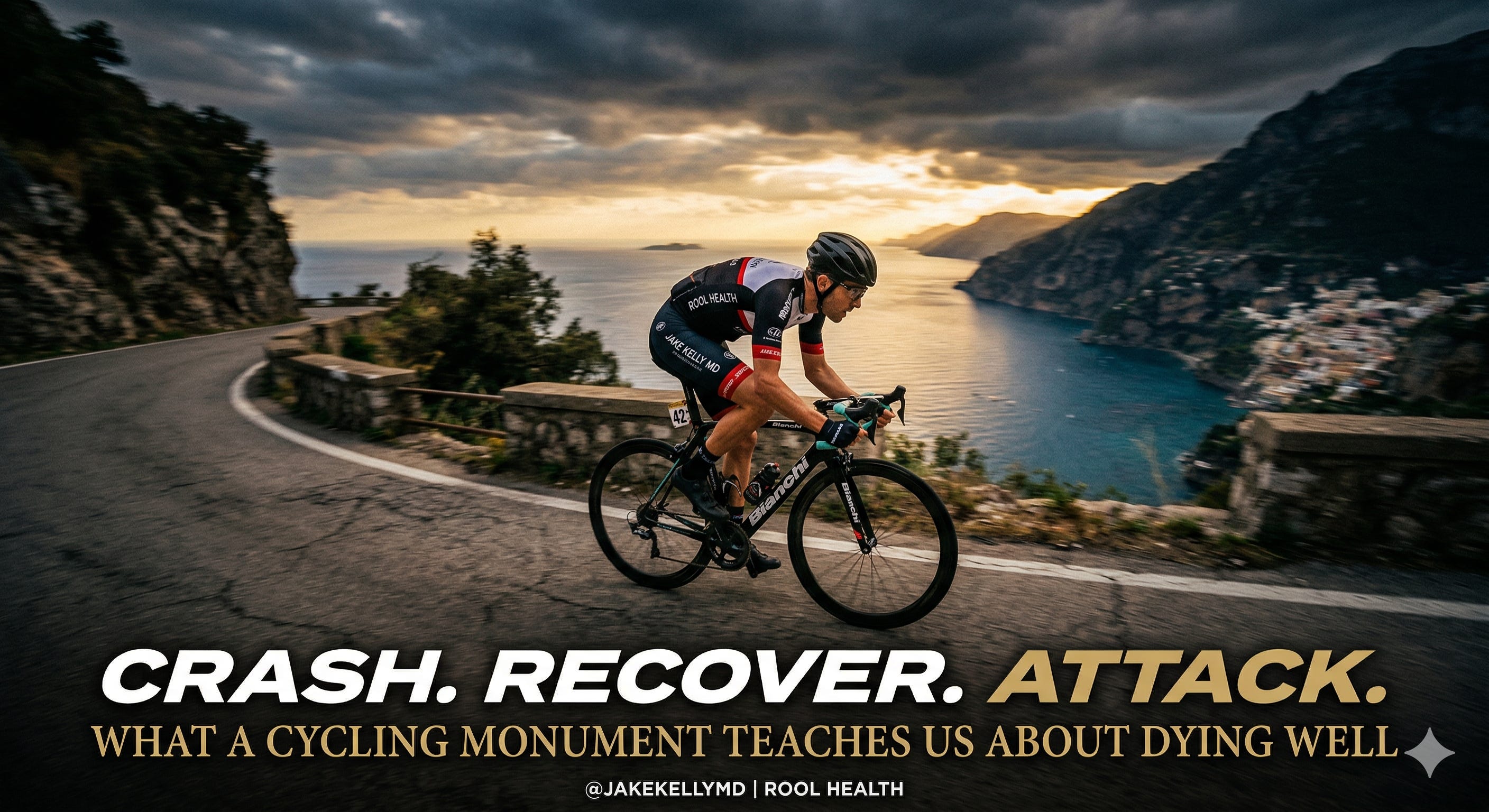
What Tadej Pogačar did yesterday at Milan-San Remo is one of the greatest displays of physiologic reserve in modern sport.
For non-cycling fans: Milan-San Remo is one of cycling’s five monuments. Nearly 300 km. Six to seven hours of racing. A long, flat day that finishes with a series of short, vicious climbs before a descent to the Via Roma, where historically, the sprinters who survived the climbs would determine the winner in a final sprint.
Pogačar has changed MSR. Four Tour de France titles. A back-to-back Giro d’Italia, Tour de France, World Cycling Championship in the same year. Now winning four of the five monuments (unimaginable in today’s modern sport of super specialization). Pogačar’s power-to-weight ratio on short climbs is so extraordinary that he’s turned a sprinter’s race into an attacker’s race.
But yesterday Tadej crashed 33 km from the finish, near the base of the Cipressa climb. His main rival, Mathieu van der Poel, the best classics rider in the world, stockier and stronger also went down in the crash.
Both had to produce sustained Zone 4 efforts just to rejoin the front. For Pogačar, longer and harder. And then, without time to recover, Tadej rode straight to the front of the Cipressa climb and destroyed it at record pace. His attack exploded the peleton with the only stragglers, van der Poel and Tom Pidcock grinding into Pogačar’s slipstream riding the short distance to the Poggio, where he quickly attacked (again), ripping the race apart, dropping Mathieu van der Poel and pulling Tom Pidcock along for their final duel at the finish. Then Tadej outsprinted Tom on the Via Roma, winning by 1/2 a bicycle wheel.
Crash. Recover. Attack. Attack again. Win.
What Does This Have to Do With You?
Everything.
Pogačar demonstrated the same physiology that determines whether you survive your eighth or ninth decade. The currency is the same: capacity above the floor.
At 27 years old and at the peak of human performance, Pogačar’s physiologic reserve is so vast that a crash, followed by a sustained high-intensity chase and two maximal climbing efforts couldn’t deplete it. Tadej still had enough reserve remaining to sprint for the win. His cardiorespiratory fitness ceiling is so high that even after repeated hits, he never approached his floor.
Now translate this extreme physiologic performance to the other end of the spectrum.
When you’re 82 and you develop pneumonia, a hip fracture or a serious infection, your body needs to produce a Zone 4 effort to survive it. Your immune system has to mobilize. Your cardiovascular system has to deliver the cardiac output to power the immune system’s army. Your musculoskeletal system has to hold stability, repair and heal.
If your reserve is high enough, you recover. You rebuild. You get a little stronger. You live another year with your family.
If your reserve is gone, this effort is your last.
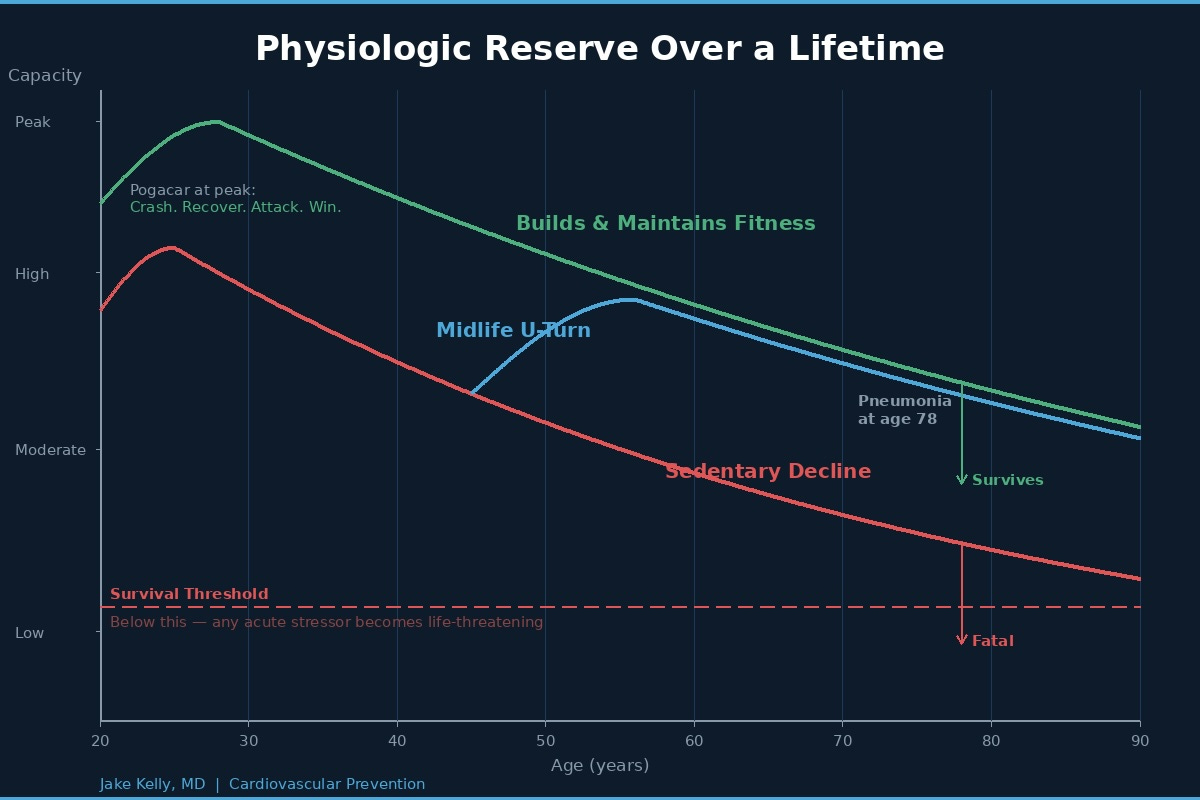
Three trajectories. Same starting point. Vastly different outcomes.
The green line represents someone who builds and maintains fitness across decades. At 78, when pneumonia hits, they drop but stay well above the survival threshold. They recover. They go home.
The red line represents a sedentary life and the persistent decline. The same pneumonia at the same age drops them below the threshold. It’s fatal. The pneumonia is not worse. The reserve isn’t there.
The blue line is possible to achieve. The Midlife U-Turn. Someone who spent decades on the red line but changed course. Rebuilt capacity in their 40s or 50s. It doesn’t get them to the green line, but it gets them (us?) far enough above the floor that when the life’s stresses hit, they survive it too.
The blue line is real. It’s never too late to start building capacity, increase our physiologic reserve and bend our curve.
The Same Physiology at Both Extremes
At one extreme, a 27-year-old world champion cyclist crashes in a cycling monument and retains enough capacity to attack twice more and win on the Via Roma. At the other, an 82-year-old with decades of built fitness has enough reserve to survive pneumonia and walk out of the hospital.
The context is different. The physiology is the same.
Raise the ceiling. Stay above the floor.
Sometimes you have to be fast, fast enough to attack the Poggio after a crash and a chase. And sometimes you have to be slow, slow enough to outlast the decline, to slow down the race to death.
Build the reserve now. You’ll need it later.
—Jake
Thank you for reminding me that as hard as this knee replacement recovery has been (just had a manipulation under anesthesia at 6 weeks to break up scar tissue), it would be harder if I hadn’t done weeks of pre-hab strengthening and if I was not a life-long exerciser.
Great analogy Jake. The subtitle of your article could've been something like "How couch potatoes push up daisies many years earlier than their active friends." I've seen it first hand with three of my sedentary friends dying in the last year (in their early to mid seventies) as opposed to an active friend who just celebrated his 84th birthday yesterday.