
Fuel the Engine
You can't out-train what you won't fuel

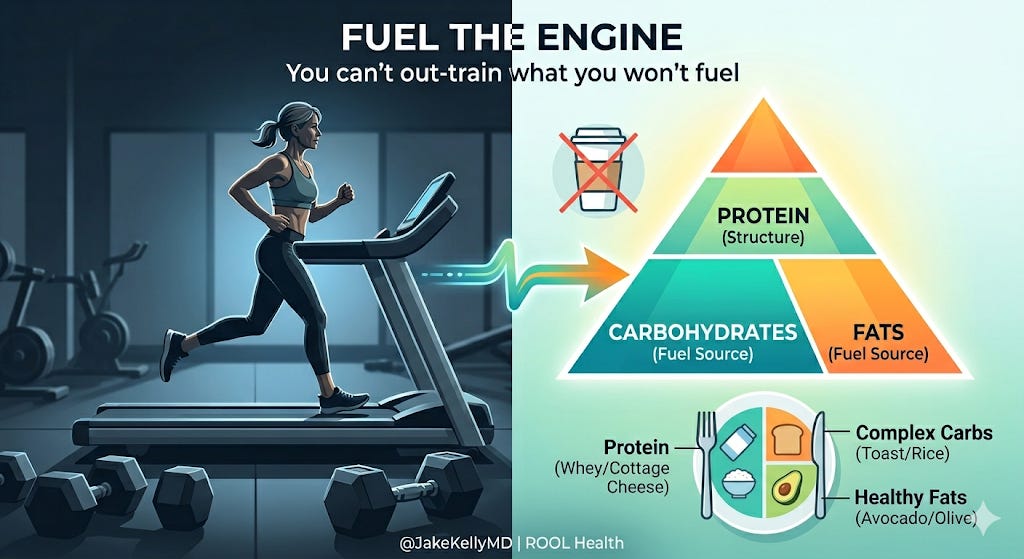
Jill sits across from me in clinic with a printout of her macros. She knows her protein number to the gram. She’s tracked it for six months. She also hasn’t eaten breakfast in twelve years.
Jill is 58. She runs four days a week. She came in frustrated. Her pace has stalled and when she adds a fifth run during the week, she end up with shin pain and feeling flat. She has attempted to add a third strength session and felt less strong. Additional workout lead to poor sleep and inadequate recovery. The harder she tries to push, the more her body pushes back.
She came in convinced she needed to add more protein to her diet.
I asked her what she ate before her run that morning.
“Coffee.”
This is the quiet mismatch I see in my patients and athletes each week. The conversation about fueling cardiorespiratory fitness has narrowed so far that we’ve lost the main theme. We’re currently hearing about about protein. You can even have a protein foam add on at Starbucks now. We have forgotten about food timing. We are overlooking that the engine you’re trying to build runs on substrates you have to actually put in the tank.
Before I go any further, the most important thing I can tell you about nutrition is this: the strategy matters less than the commitment to it. Total energy in and the macronutrient (protein, fats AND carbohydrates) balance that sit underneath are the dominant variables for successful fueling. Timing, fasting windows, substrate context, all the things I’m about to talk about: these are helpful nutrition topics and strategies, but they are second-order. If you find a system you believe in and you actually follow it, you have already done most of the work.
What follows is the nuance on top of that foundation.
The morning underfueling problem
I see this most in my patients over 50, and it almost always looks the same. A small breakfast or none at all. A workout session layered on top. Then a day spent climbing out of a nutrition deficit.
This isn’t discipline. It’s poor nutritional strategy.
The aging body is less forgiving of energy gaps than the 25-year-old body was. Protein synthesis becomes more resistant to small meals. Glycogen stores recover more slowly. The hormonal buffer that lets a young athlete train fasted and recover fine begins to thin out.
Underfueling in midlife doesn’t make you leaner. It makes you frailer. There is good evidence that low energy availability, even without overt disordered eating, suppresses bone turnover, blunts the training response, and elevates resting cortisol.
This isn’t only a story about athletes. The other patient I see on the same day is the one who has a slice of toast and a coffee at 7, grazes on pretzels and almonds through the afternoon, crashes at 3 PM, and tells me they “just don’t have the energy to exercise.” They aren’t training for anything. That’s the point. They’ve been living in a quiet daily nutritional deficit for so long that their body has stopped expecting real meals. Without an exercise stimulus to force adaptation, the drift downward in fitness is slow, harder to feel and not apparent until the labs or long airport transfer start revealing a story the patient didn’t see coming.
The physiology is the same. The fix is the same. The margin for error is actually smaller, because there’s no exercise training volume to mask what the body is doing.
The first fix is almost embarrassingly simple. Eat in the morning. Whether you’re training for something or just trying to feel human by 2 PM.
The protein obsession
Protein deserves a seat at the table. It does not deserve the whole table.
The current evidence in aging athletes is reasonably clear: the old 0.8 g/kg/day RDA is a floor designed to prevent deficiency. It is not a target for someone trying to preserve muscle and build cardiorespiratory capacity into their seventies. The PROT-AGE consensus recommends 1.0 to 1.2 g/kg/day for healthy older adults and 1.2 to 1.5 g/kg/day for those with acute or chronic illness. The ISSN position stand on protein and exercise is higher: 1.4 to 2.0 g/kg/day for exercising individuals. Morton’s 2018 meta-analysis suggests benefits to muscle mass and strength continue up to about 1.6 g/kg/day, with diminishing returns above this threshold.
Synthesizing across these: a reasonable working range for an aging athlete is 1.2 to 2.0 g/kg/day, with the upper end reserved for those doing real strength work, training in a caloric deficit, or recovering from illness or injury.
Distribution of protein throughout the day is important. Three to four feedings of 0.4 g/kg of high-quality protein appears to drive muscle protein synthesis more effectively than the same total dumped into one meal.
What does that actually look like on a plate? Let’s make it concrete.
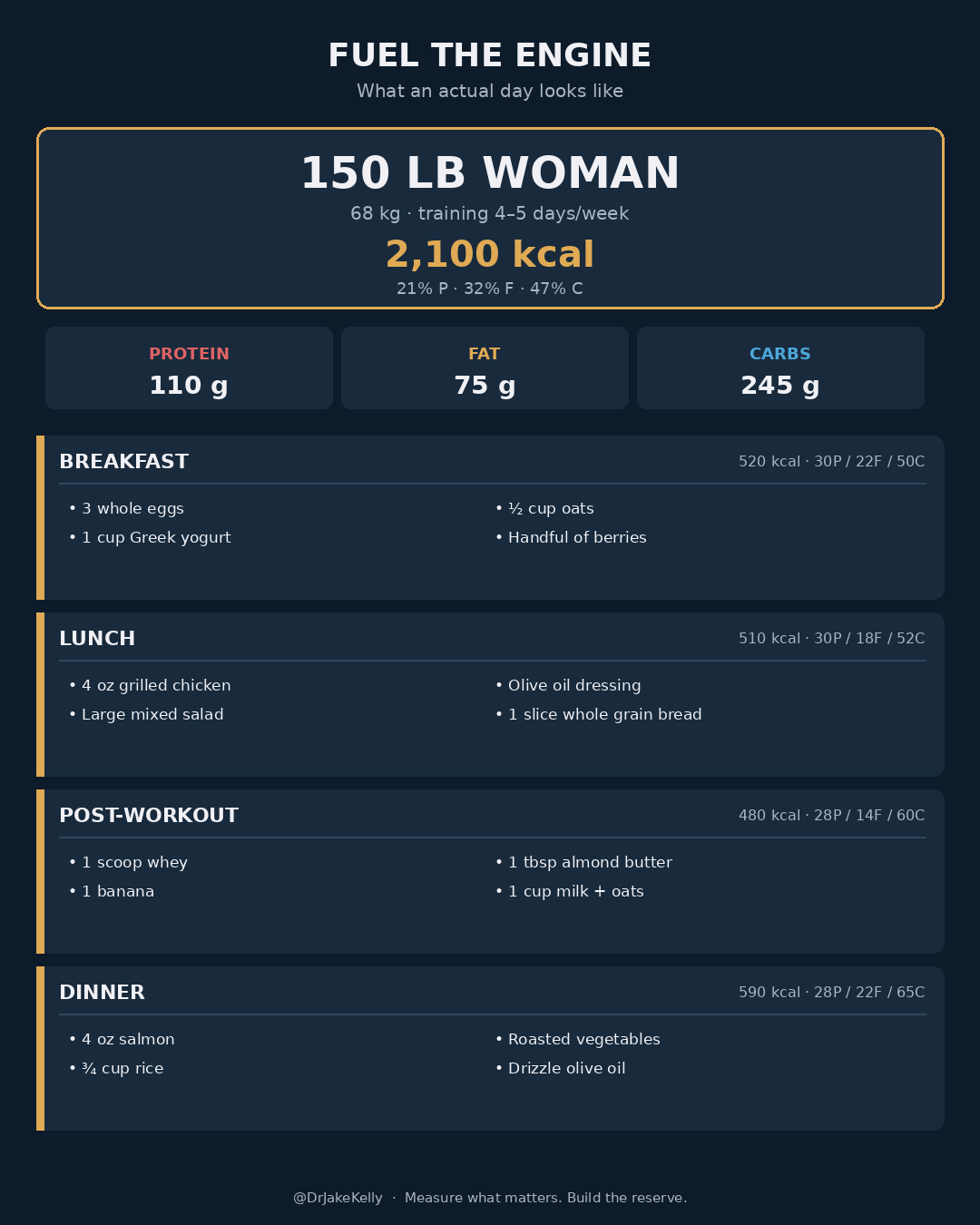
A 150 lb (68 kg) woman training for cardiorespiratory fitness is roughly 110 g of protein per day, or about 27 g per meal across four meals. Three eggs and a cup of Greek yogurt at breakfast. A palm of grilled chicken (4 oz) on a salad at lunch. A scoop of whey in a recovery smoothie after training. A 4 oz piece of salmon at dinner.
A 180 lb (82 kg) man is roughly 130 g per day, or about 33 g per meal across four meals. Four eggs and a slice of cheddar at breakfast. A 5 oz chicken breast or two cans of tuna at lunch. A protein shake or a cup of cottage cheese mid-afternoon. A 5 oz piece of beef, salmon, or chicken at dinner.
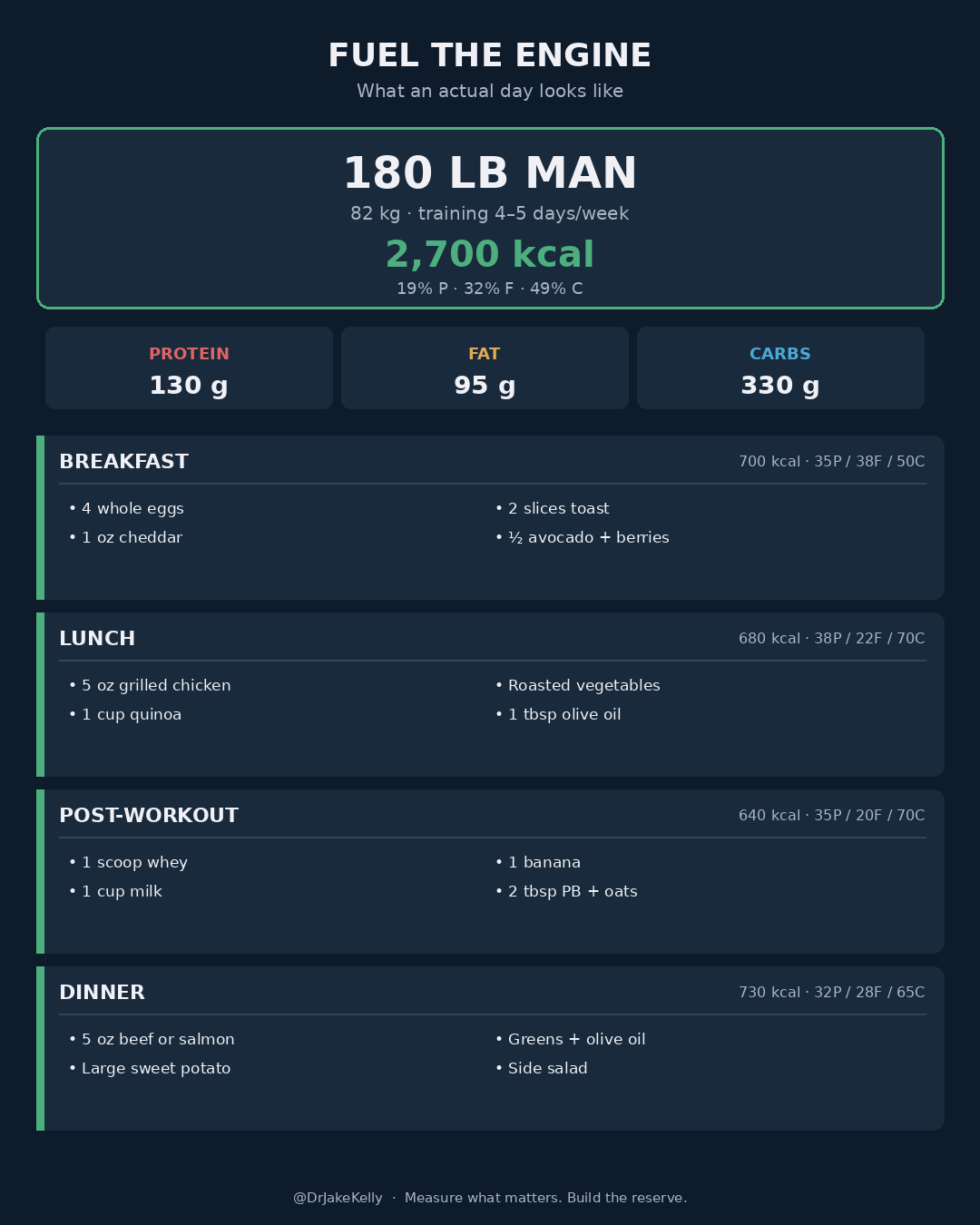
Neither of these daily nutrition intake strategies are complex. They don’t require a tracking app. The point is that hitting the target macronutrient distribution becomes routine (and relatively easy) once you see what a meal is supposed to look like.
But here’s what gets lost in the protein conversation: fat and carbohydrate are not the enemy of the engine. They are the engine. Your mitochondria do not burn protein during a Zone 2 ride. They burn fatty acids and glucose. Crowd these important macronutrient out through fear, fasting culture, through influencer protein noise and you end up starving the very system you came to train.
Fasted vs fed… the duration rule I follow
The fasted training conversation is more nuanced than either side admits.
Two definitions before we go further.
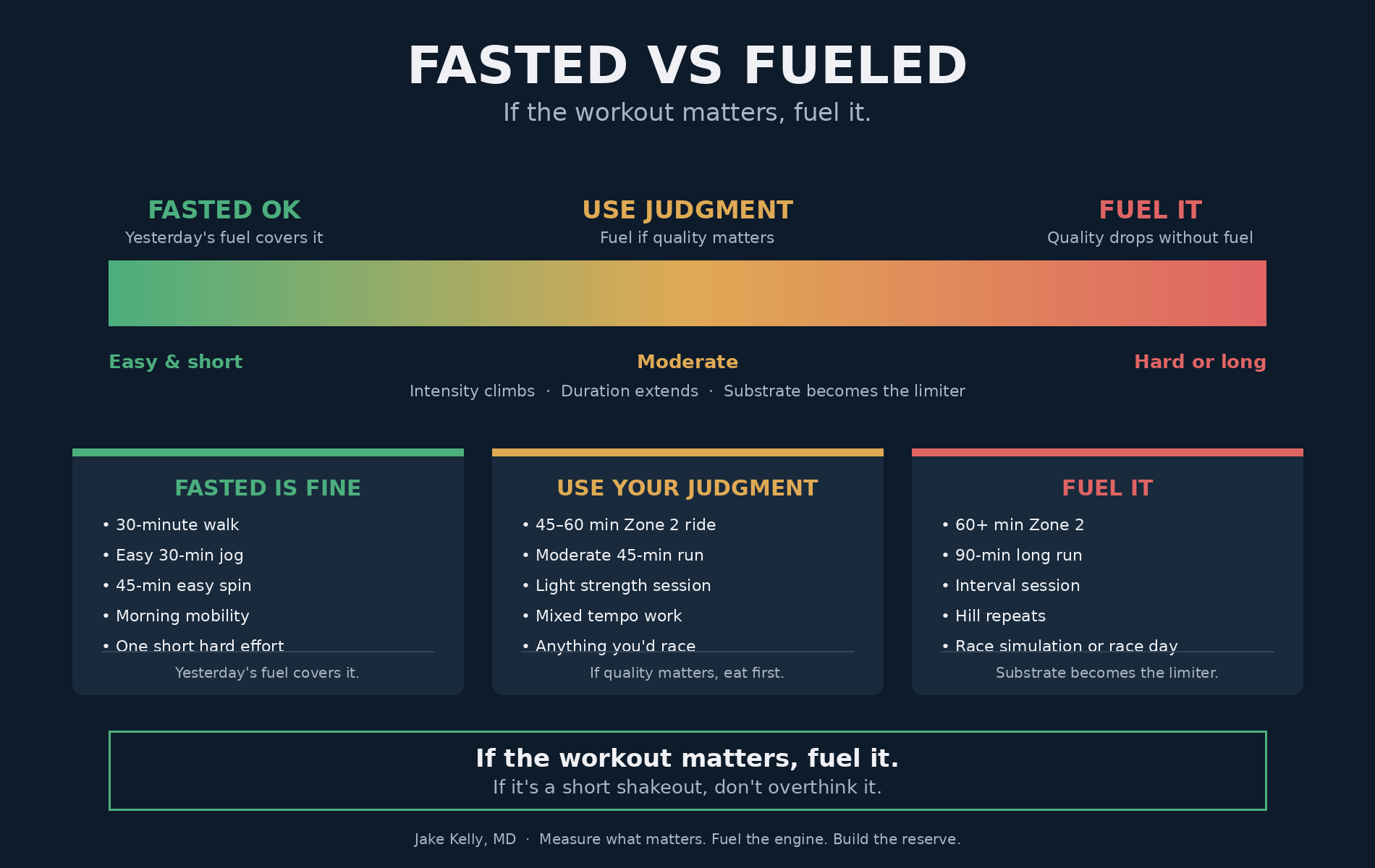
Short and easy means exactly that. A 30-minute walk or easy jog. A 45-minute easy spin on the bike. A morning mobility session. Any session where the heart rate stays low, the duration is modest and the goal is movement rather than stress or load adaptation. For this kind of physical activity or work, fasted is fine. You’re not asking the body to do anything it can’t comfortably do on yesterday’s fuel.
Hard or long is everything else. A 60-minute Zone 2 ride. A 90-minute long run. A strength session that asks the body for real physical output. An interval workout: hill repeats, threshold work, anything where you are visibly working hard and breathing hard. The moment intensity climbs or duration extends past about an hour, fasted training quietly degrades the quality of the work. Power drops. Perceived exertion climbs. The session you came to do is no longer the session you’re actually doing.
My honest read on the literature: there isn’t a clean minute-count that separates “fasted-safe” from “needs fuel.” It’s a sliding scale of intensity and duration. The further you move along either axis, harder effort or longer session, the more substrate availability becomes important. A short, single hard effort in isolation may be fine fasted. Accumulated hard work throughout the week (or months) from daily aerobic work, strength sessions, and interval high intensity sessions is where your flatness or inability to push will show up.
There may be small mitochondrial signaling benefits to occasional low-glycogen sessions, an idea that has matured under the heading of “train-low, compete-high” periodization. These are tools for advanced athletes following a plan with their coach, not a default mode for everyone, every day of the week.
A reasonable rule: if the workout matters, fuel it. If it’s a short shakeout, don’t overthink it.
Substrate availability and Zone 2
Zone 2 training is supposed to teach your mitochondria to oxidize fat efficiently; to push the crossover fat burning point higher, so that at any given workload you’re sparing glycogen and burning more fat. Iñigo San-Millán and George Brooks have done some of the best work mapping this physiology in elite athletes.
But the substrate you actually burn during a Zone 2 session is not determined only by your fitness. It’s also shaped by what’s available. What’s available is shaped by what you ate in the previous 12 to 24 hours.
A high-fat meal the night before will tilt the next morning’s session toward fat oxidation. A high-carb meal will tilt it toward glucose use. A 14-hour overnight fast will push you toward fat by depletion rather than by adaptation, which looks the same on a metabolic cart but is not the same training stimulus.
We don’t yet know the optimal substrate context for every Zone 2 session. What we do know is that chronic underfueling does not accelerate fat oxidation. It accelerates injury, illness and dropout.
Train the system. Don’t starve it.
My personal practice: The 12-hour window
What’s worked for me, for years now, is a simple 12-hour eating window. Some days 6 AM to 6 PM. Some days 8 AM to 8 PM. This is not a fasting protocol. Or a weight-loss tool. It is a rhythm.
The case for using a time restricted eating interval isn’t religious. It’s mechanical:
The gut gets time to digest and repair. The microbiome gets a window without new input. There’s now reasonable evidence that this kind of circadian eating pattern improves microbial diversity and metabolic markers.
I stopped snacking between meals almost as a side effect. And my health markers followed. My fasting glucose normalized. My HbA1c moved into very healthy range. My triglycerides went from acceptable to genuinely good.
That’s an n of one. But it’s an n of one with labs.
I’m not prescribing a 12-hour window to every patient. Some need a wider one. Some need to eat more often, not less. The point is the principle: build a relationship with food that has structure, rest periods and respects the circadian rhythm of the gut and the metabolism. This principle holds up across most of the literature I trust.
Fuel the Engine
Step back from all of this for a moment.
The single biggest predictor of whether a nutrition strategy works is not the strategy. It’s whether you believe in it enough to follow it. Mediterranean. Higher protein. Plant-forward. Time-restricted. Whole-food omnivore. The literature is full of trials where two opposing diets produce nearly identical outcomes because adherence, not assignment, was doing the work.
So the hierarchy I’d offer is this:
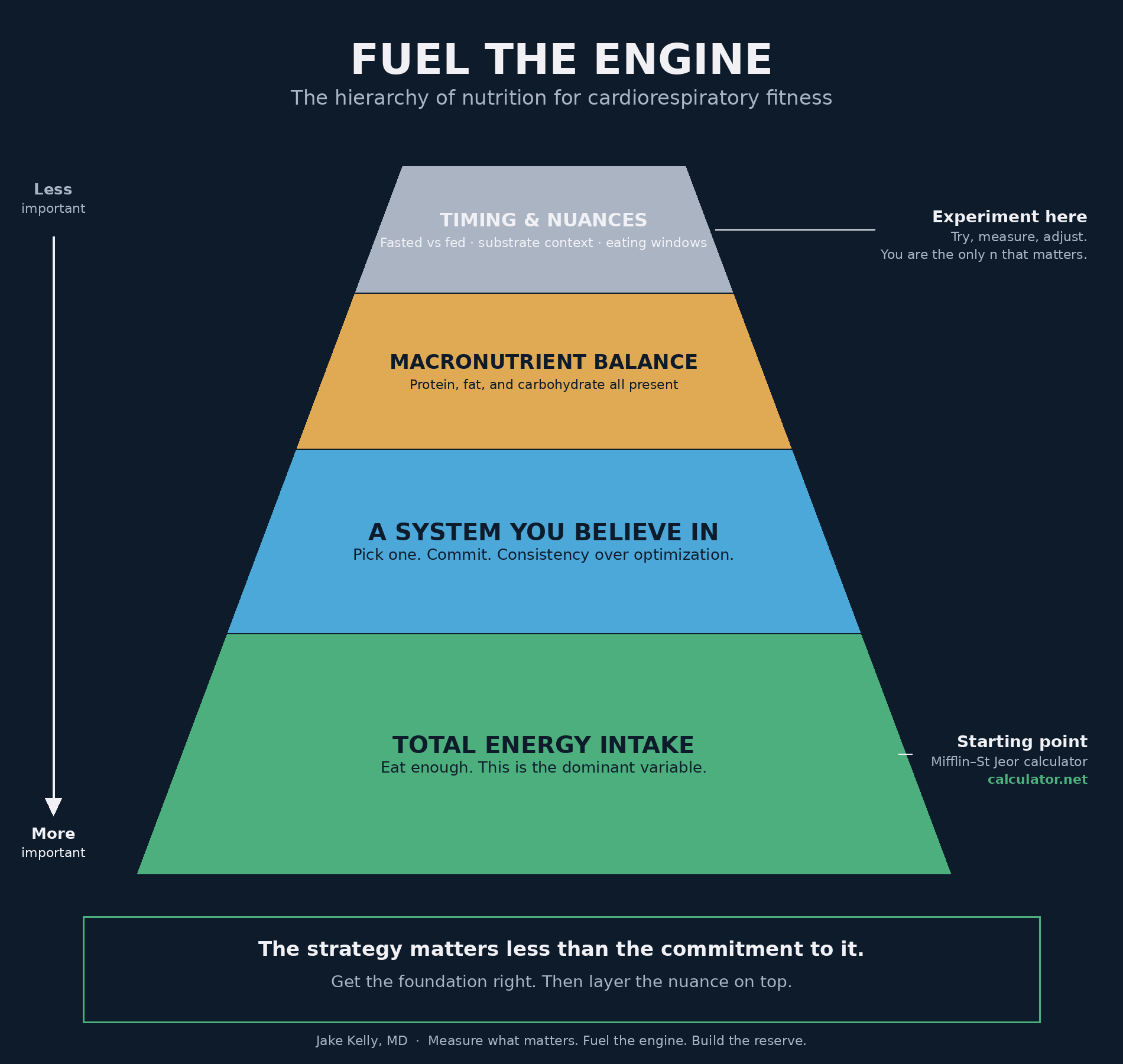
First: total intake and macronutrient balance. Are you eating enough? Are protein, fat, and carbohydrate all present in meaningful amounts? This is the dominant variable. Get this wrong and nothing downstream rescues it. If you don’t have a starting point, plug your numbers into a basic Mifflin–St Jeor calculator like the one at calculator.net. It is not perfect. It is a starting point. That is exactly what you need.
Second: a system you believe in. Pick one. Commit to it. Consistency over months and years beats optimization over weeks. Whichever framework you choose, give it enough runway to actually work, months, not weeks, before you judge it.
Third: the nuances. Timing. Fasted vs fed. Substrate context. Eating windows. These can be important. They should be layered on top of a foundation that has to be solid first. This is also the layer where you get to experiment. Try a fueled long run for a month and see how recovery feels. Try a 12-hour eating window and watch your fasting glucose. Move dinner earlier. Add a pre-workout banana. You are the only n that matters here. Nuance is where you find your version.
With that hierarchy in mind, the rules I keep coming back to:
Eat enough, and eat early enough. Most underfueled patients don’t need a new diet. They need a breakfast.
Match the fuel to the work. Short and easy can be fasted. Long and meaningful should be fueled.
Let protein scale with age and load. 1.2 to 2.0 g/kg/day for most aging athletes. Distributed across the day. Not hoarded into dinner.
Don’t crowd out the substrates that actually burn. Fat and carbohydrate are not optional accessories to a protein plan. They’re the fuel for the engine you’re trying to build.
Give the gut a window. Twelve hours without input, most nights. This is not a protocol. A rhythm.
Pick a system. Believe in it. Follow it. This rule sits above all the others.
You can’t out-train what you won’t fuel. And whether you’re training for something or just trying to feel like yourself by the afternoon, you can’t build cardiorespiratory fitness, or metabolic health, improve energy, or a body you trust on a system that’s running on fumes by 9 AM.
The engine is real. The fuel is real. The timing is real.
Treat all three with the same seriousness you treat your training plan and the body will quietly do what it was built to do.
Measure what matters. Fuel the engine. Build the reserve.
A question for you:
Are you a fasted runner or a breakfast believer? What have you noticed in your own training, your recovery, and your labs? Drop a comment below. I read them all and the best discussions in this community happen when people share what’s actually worked (and what hasn’t).
References
Mountjoy M, et al. IOC consensus statement on relative energy deficiency in sport (RED-S): 2018 update. Br J Sports Med. 2018;52(11):687-697.
Melin AK, Heikura IA, Tenforde A, Mountjoy M. Energy availability in athletics: health, performance, and physique. Int J Sport Nutr Exerc Metab. 2019;29(2):152-164.
Bauer J, et al. Evidence-based recommendations for optimal dietary protein intake in older people: a position paper from the PROT-AGE Study Group. J Am Med Dir Assoc. 2013;14(8):542-559.
Jäger R, et al. International Society of Sports Nutrition position stand: protein and exercise. J Int Soc Sports Nutr. 2017;14:20.
Morton RW, et al. A systematic review, meta-analysis and meta-regression of the effect of protein supplementation on resistance training-induced gains in muscle mass and strength in healthy adults. Br J Sports Med. 2018;52(6):376-384.
Areta JL, et al. Timing and distribution of protein ingestion during prolonged recovery from resistance exercise alters myofibrillar protein synthesis. J Physiol. 2013;591(9):2319-2331.
Hawley JA, Burke LM. Carbohydrate availability and training adaptation: effects on cell metabolism. Exerc Sport Sci Rev. 2010;38(4):152-160.
Impey SG, et al. Fuel for the work required: a theoretical framework for carbohydrate periodization and the glycogen threshold hypothesis. Sports Med. 2018;48(5):1031-1048.
San-Millán I, Brooks GA. Assessment of metabolic flexibility by means of measuring blood lactate, fat, and carbohydrate oxidation responses to exercise in professional endurance athletes and less-fit individuals. Sports Med. 2018;48(2):467-479.
Volek JS, et al. Metabolic characteristics of keto-adapted ultra-endurance runners. Metabolism. 2016;65(3):100-110.
Burke LM, et al. Low carbohydrate, high fat diet impairs exercise economy and negates the performance benefit from intensified training in elite race walkers. J Physiol. 2017;595(9):2785-2807.
Chaix A, et al. Time-restricted eating to prevent and manage chronic metabolic diseases. Annu Rev Nutr. 2019;39:291-315.
Wilkinson MJ, et al. Ten-hour time-restricted eating reduces weight, blood pressure, and atherogenic lipids in patients with metabolic syndrome. Cell Metab. 2020;31(1):92-104.
Gardner CD, et al. Effect of low-fat vs low-carbohydrate diet on 12-month weight loss in overweight adults and the association with genotype pattern or insulin secretion: the DIETFITS randomized clinical trial. JAMA. 2018;319(7):667-679.
Nice article. Jill’s pattern is almost identical to what I see in my metabolic patients. Chronic underfueling, particularly skipping breakfast, creates a sustained cortisol elevation that destabilizes glucose regulation throughout the day and accelerates visceral fat accumulation over time. The liver feels this first. In patients with early metabolic liver disease, morning underfueling is one of the most consistent and most overlooked drivers of disease progression I encounter in clinic. The engine analogy is exactly right. You cannot expect metabolic resilience from a system you are quietly starving.
Hello Jake, why whey ? Why UPF food with emulsifiers ?
IMHO, there is no need to seek for a perfect protein goal after a workout. We have got long timeframes/rythms in the body to adapt. I have fallen in the trap to chase every optimization for my sports endeavors and I feel we have an epidemic of optimization chasers that lead to some level of performance anxiety and burnout. Eat real food with variety, eat food you cook seems like a good pattern to me…
To answer your question I almost always eat before the morning workout. I can train fasted, I do not fear this, but it’s not in my habits. (A very good friend of mine who has done Tor des géants twice runs 17k fasted everyday.)