
Slow It Down to Push It Up
Zone 1 isn’t just a heart-rate zone: it’s a way of living

The air was just above freezing when I clipped in.
Slick roads. Pale sun. A long shadow behind me on the Anchorage trail.
Daylight savings had thrown off my sleep, but I’d gotten enough. A Zone 1 ride: twenty miles of slowly spinning, low heart rate, high clarity. Then a quick shower, family breakfast, and a 2-kilometer walk with everyone bundled in layers.
Somewhere between mile eight and nine, a phrase landed in my head:
“Slow it down to push it up.”
It stuck. The cadence of the pedals matched the words, and the meaning went deeper than cycling.
Zone 1 for the Heart and the Mind
In training, Zone 1 is your lowest gear. Easy effort, barely breathing hard. Fat-oxidation zone. Long-duration, low-intensity work that quietly rewires your mitochondria and vascular system.
Most people skip it because it feels too easy.
But here’s the paradox: the athletes who go slow enough, often enough, end up being the ones who can go hardest, longest, and recover fastest.
Physiology is full of poetry if you listen to it.
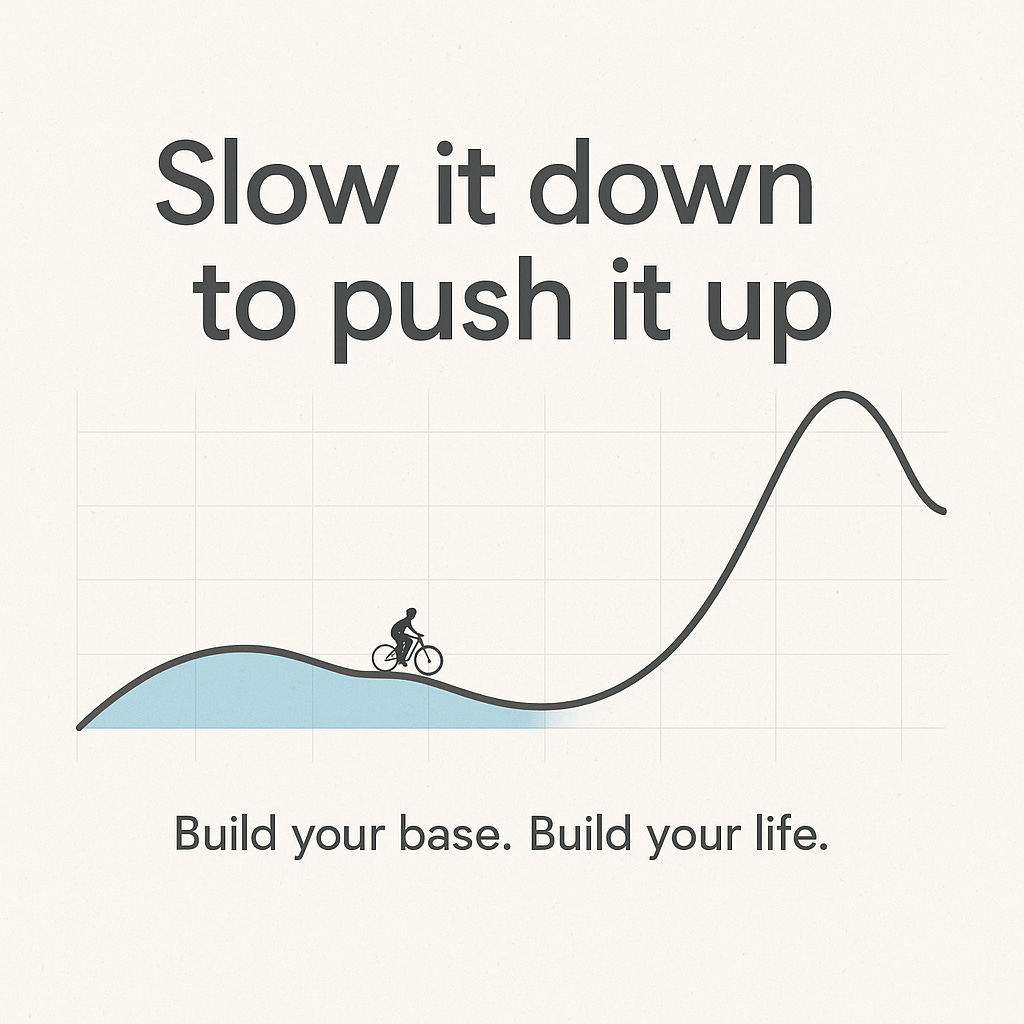
When you build an aerobic base, you’re not just getting fitter…you’re increasing the ceiling of what your body can do under stress. The same is true for your brain and your life.
When you move slowly, breathe deeply, and stop rushing from one task to the next, you’re raising your capacity to think clearly, to create, to connect.
You can’t rush endurance.
Not in sport.
Not in life.
Six Months of Slowing Down
Six months ago, I made a big step toward a new future. I initiated a monumental change in how I will now work. I gave up something of enormous value and importance to me. It was a risk. It still is.
No more overnight call. No more rushing from one consult to the next, inbox overflowing.
Three months from now, I’ll be on a tighter budget but with a different kind of certainty growing underneath: clarity.
In those six months, I’ve started writing weekly. I’ve spent more mornings with my family. I’ve trained consistently, slept better, and thought more deeply about what kind of doctor and human I want to be.
Stepping back gave me something I hadn’t realized I’d lost: mental space.
Space to think, to feel, to plan, to be creative again.
Space to ask better questions:
What am I actually passionate about?
What kind of medicine do I want to practice for the next twenty-five years?
How can I help more people without losing myself in the process?
Medicine 3.0 and the Human Revolution
Artificial intelligence is changing everything: imaging, diagnostics, lab interpretation, even clinical notes. It’s both exciting and unsettling.
But here’s the truth:
Technology will only make medicine better if it makes it more human.
Machines can process data, but they can’t care.
They can’t look a patient in the eyes, listen to a story, or understand the fear beneath the symptoms.
Medicine 3.0 is the post-AI, performance-driven, prevention-focused version of healthcare will still depend on something no algorithm can replicate: human connection.
That’s what I want more of.
Not 24 patients a day; one at a time.
Knowing their goals, not just their lab results. Helping them live better, longer, with clarity and purpose.
The Same Rules That Raise Kids and VO₂ Max
We already know how humans learn and grow: attention, repetition, nourishment, rest.
If you want a child to develop curiosity and intelligence, you read to them. You talk with them. You give them sleep, good food, movement, and love. You do it again and again and again.
Adults are no different.
Slow, consistent, intentional effort rewires the brain and the body.
That’s the secret of longevity training but it’s also the secret of becoming a better human being.
What This Means for You
Maybe your version of “Zone 1” isn’t a bike ride. Maybe it’s walking your dog, gardening, stretching, or sitting in silence for five minutes before opening your laptop.
It all counts.
Every moment of slowing down physically, mentally, emotionally is an investment in your future capacity. You’re building aerobic endurance for your life.
So this week, I invite you to find your version of slow.
Move gently. Think clearly. Speak kindly.
And when the time comes to push, whether in training, work, or purpose you’ll find yourself stronger than before.
I’m up early today on my son’s eighth birthday, and we’ll celebrate with donuts (his choice) in a few hours.
Twenty-plus years in medicine have repeatedly humbled me with this truth: medicine is still a noble profession. And I’ll keep practicing it, in whatever form it takes, for as long as I’m useful.
But the past six months have taught me something equally important:
To heal others, you have to make space to heal yourself.
So today, before you speed up:
Slow it down.
Then push it up.
— Jake
Hello from overseas !
I’m 44 yo, in 2016 or 2017 I don’t recall exactly I have started to work part time. One day off a week. 20% drop in income. One of my best decision ! On the other side, I am ok to retire later if I am still able to do the job according to my standards.
About AI, it’s one thing I like with endurance : no shortcuts. Nothing can’t do the job but you.
Last but not least, about slowing down, I have had the chance to do the Tour of Corsica by bike with friends. Day in day out on the bike with marvellous sceneries. One day, we were crossing an old village. A very old men looked at us with the typical stare of these old guys. He was walking so slowly… not a frail gait, he was just epitomizing slowness. A bit like if he knew death was closer and closer and going slower pushed it away. Back to my everyday life, I feel too often in a rush and remember this guy to slow me down and mimic the old Corsican guy’s gait.
Cheers ! And happy birthday to Mini Jake !
The “daily constitutional” has been recognized by historical figures whose ideas have been hugely influential such as Thoreau. It has been shown to promote creativity, de-stress (modulate the autonomic nervous system), and more. There’s something about doing so in nature that seems especially beneficial. Here’s an interesting podcast that discusses some of these ideas.
https://podcasts.apple.com/us/podcast/hidden-brain/id1028908750?i=1000735095031