
Strength Training for Life: Squats, Deadlifts & Longevity
Why these two movements deserve a place in your week—whether you’re 25, 55, or 75.

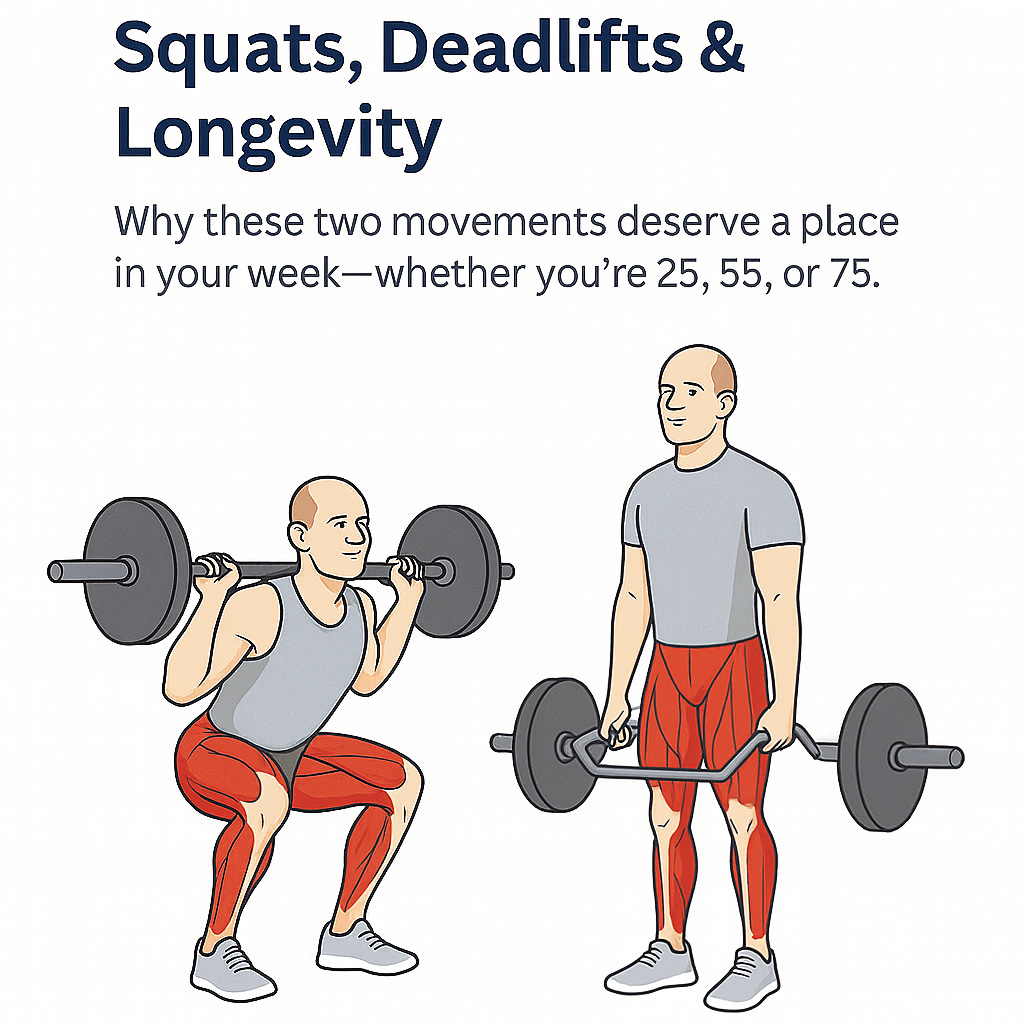
The Missing Pillar
When most people think about health, they think about heart and lungs. VO₂ max, blood pressure, cholesterol. As a cardiologist, I love seeing these numbers improve. But there’s a critical pillar of health that Medicine 2.0 often ignores: strength.
Strength isn’t about your one-rep max or how much you can bench press. It’s about your chassis: the frame that supports everything else. Without it, even the best aerobic engine won’t get you very far. I’ve experienced the limitations of an aging chassis firsthand.
Strength is what allows you to lift a suitcase into the overhead bin, catch yourself if you stumble on a curb, or hike a trail with your kids or grandkids. It’s protective against falls, frailty, and even metabolic disease. In fact, grip strength and leg strength are among the most powerful predictors of survival we have in longevity research [1–3].
Your strength is your insurance policy for independence.
Why Squats and Deadlifts?
If you could only pick two strength movements for life, they’d be the squat and the deadlift (hip hinge).
Squats mimic sitting, standing, and climbing stairs. They build quads, hamstrings, glutes, calves, and core.
Deadlifts (hip hinges) replicate picking something up off the ground. They train the posterior chain: hamstrings, glutes, lower back, and grip.
Together, these movement patterns capture much of daily life: sit, stand, hinge, lift, carry. They are not “gym bro” lifts. They are life lifts.
A Personal Note: My Hamstring Weakness
As a lifelong runner and cyclist, I morphed into a one-plane chassis in midlife. Strong in straight-ahead movement, but limited in the lateral and rotational dimensions that real life demands.
Eventually, this imbalance caught up with me. I developed proximal hamstring tendinopathy (where the hamstring attaches to the pelvis). I reached my breaking point when I experienced throbbing butt to leg pain that made me want to jump out of my airplane seat on a family trip to Hawaii. Later, it became more of a deep ache, robbing me of range of motion and power. Sitting for more than 20–30 minutes and short drives to work were painful.
For years, I coped by ignoring it, hiding behind blinders while running, cycling, and daily activities grew slower and more uncomfortable. Until I one day I couldn’t take it anymore.
What helped me recover (and what I still rely on daily) wasn’t rest, but a steady commitment to glute and hamstring strength. Hip hinges, split squats, and bridges paired with mobility work to restore range of motion. These aren’t just rehab exercises. They’ve become a weekly staple in my lifelong practice of movement. Strength and mobility are the counterbalance to endurance. Without them, my chassis breaks down.
My Hamstring Protocol
The core movements I return to, week after week, to keep my posterior chain strong and pain-free:
Strength
Romanian Deadlifts (RDLs): Slow, controlled, hinge-focused.
Squats (bodyweight → dumbbell → barbell): Full range of motion (if possible), heels grounded, core tight.
Single-leg Glute Bridges: Activation + symmetry.
Bulgarian Split Squats: Unilateral strength + balance.
Mobility
Lateral banded walks + clamshells
Hip openers
Hamstring flossing
Dynamic stretches before runs
Strength and mobility aren’t short-term rehab; they’re long-term insurance.
Beyond the Big Two
Squats and deadlifts are the foundation, but they’re not the whole picture. To train for life, we also need to push, pull, carry, and resist rotation.
I’m gradually building a YouTube library that will demonstrate these patterns: squats, deadlifts, presses, rows, carries, and core stability work. These demonstrations will illustrate the exercises using bodyweight, bands, dumbbells, and barbells. Over time, it will grow into a resource for all ages and fitness levels, with examples from me, Katie, our kids, and my parents.
Tip: If you’re new to strength training, I recommend working with a personal trainer, physiotherapist, or physical therapist to build a program tailored to your body and needs. That’s what I’ve done (and continue to do), and it has been invaluable.
How Much Is Enough?
This is not about bodybuilding or powerlifting. It’s about reinforcing your chassis.
From a longevity perspective, the prescription is modest but powerful:
Frequency: 2–3 sessions per week
Volume: 2–4 sets of 8–12 reps per exercise [4]
Progression: Choose resistance that feels challenging but repeatable
Time: 20–30 minutes per session is enough
Consistency, not marathon gym sessions is what counts.
The Role of Mobility
Strength without mobility is brittle. Mobility without strength is unstable. Both are required for lifelong movement.
Mobility doesn’t have to be complicated:
Hip openers + hamstring mobility drills
Thoracic spine rotation work
Ankle dorsiflexion stretches
A few minutes before or after training makes strength safer and life more fluid.
Stronger Than Life Demands
The goal isn’t chasing PRs; it’s building enough reserve that everyday life feels effortless:
Pick up a suitcase without straining your back.
Put it in the overhead bin with confidence.
Catch yourself if you trip on a curb.
Carry groceries upstairs without breaking stride.
These aren’t small wins. They’re the difference between dependence and independence as we age.
The Longevity Connection
Muscle mass and strength begin declining as early as our 30s, accelerating after age 50 [5]. That’s sarcopenia—the slow erosion of strength that robs people of independence. But it’s not inevitable. Resistance training preserves muscle, bone density, insulin sensitivity, and metabolic health across the lifespan [6].
And here’s the part most endurance athletes miss: strength training protects your aerobic fitness. VO₂ max is critical for healthspan, but it can only be pushed safely if the body is resilient enough to handle the training. A strong chassis supports a strong engine.
Longevity isn’t just about living longer; it’s about moving powerfully, confidently, and without fear.
Getting Started
If you’re new, start small: twenty minutes, twice a week. Focus on movement patterns, not perfection. Squat, hinge, push, pull, carry, and resist rotation.
If you’ve been lifting for years, reframe your training. Don’t just chase numbers; chase balance, resilience, and strength that serves your life.
Closing Thought
Squats and deadlifts are not optional. They’re foundational. They belong in your week whether you’re 25, 55, or 75.
Because at the end of the day, this isn’t about lifting weights…it’s about lifelong movement.
References
Leong DP, et al. Prognostic value of grip strength: Prospective cohort study of 140,000 subjects. Lancet. 2015.
Celis-Morales CA, et al. Associations of grip strength with cardiovascular, respiratory, and cancer outcomes and all cause mortality. BMJ. 2018.
García-Hermoso A, et al. Muscular strength as a predictor of all-cause mortality in an apparently healthy population: A systematic review and meta-analysis of data from approximately 2 million men and women. Arch Phys Med Rehabil. 2018.
American College of Sports Medicine. Progression models in resistance training for healthy adults. Med Sci Sports Exerc. 2009.
Goodpaster BH, et al. The loss of skeletal muscle strength, mass, and quality in older adults: The Health ABC Study. J Gerontol A Biol Sci Med Sci. 2006.
Frontera WR, et al. Strength training in older adults: Effects on muscle function and health. J Am Geriatr Soc. 2000.
Behm DG, et al. The importance of core training for sport performance and injury prevention. Sports Med. 2010.
Legal Medical Disclaimer
The information provided on this site—including articles, newsletters, social-media posts, videos, and downloadable resources—is intended for general educational purposes only and does not constitute medical advice, diagnosis, or treatment.
Your use of this content does not establish a physician–patient relationship with me or any contributor. Always seek the guidance of your own physician or another qualified health-care provider before beginning an exercise program, undergoing diagnostic testing, making lifestyle changes, or starting or stopping any medication or supplement.
Never disregard professional medical advice or delay seeking care because of something you have read here. If you think you may have a medical emergency, call 911 (or your local emergency service) immediately.
Yes 🙌. Such a great tool for post menopausal women! Where there is evidence that strength exercises can be beneficial for improving strength, physical activity, bone density and hormonal and metabolic levels. https://pmc.ncbi.nlm.nih.gov/articles/PMC9864448/
Love the explanation of why the squat and deadlift! You also have a great discussion on need for multi-planar work—now take that concept and add directional lunges to the workout. The overhead luggage maneuvering will benefit from push, pull and lift exercises. So many band, ball and weighted options exist for that. Looking forward to the additions to your program library!