
What’s Worth Measuring?
A cardiologist wore four wearables for 30 days. What will he learn?

The Wall Street Journal asked which wearable device is the best. STAT News asked if any wearable device is ready for the clinic. My fellow cardiologists have criticized the lack of precision and that the wearable numbers don’t lead to changes in clinical decisions. A viral LinkedIn post shared that they as a health coach had “graduated from wearables.”
All the authors and physicians share valid concerns, criticisms and conclusions. But I think they may have asked the wrong questions.
I’m writing a series to explore and describe my personal journey using wearables in a more structured way to show all of you how to review wearable data in an objective way while I hopefully incorporate a subjective perspective. My hope is to identify some of my misaligned behaviors, teach some physiology along the way and just maybe show all of you what they’re all missing.
The experiment
I’ve been tracking my resting and exercise heart rates and heart rate variability (HRV) since 1999 and 2022, respectively. I started wearing Polar watches at the beginning of my triathlon career. I became interested in HRV during my Cardiology fellowship (2012-2015) forgot about it and rekindled my personal interest and began monitoring daily in 2022. I’ve prescribed and performed lactate testing, DEXA scans, run and cycle heart-rate and watt ramp studies along VO₂ max testing in athletes and patients throughout this same time period. But I’ve never monitored all of these data points in a structured, documented way for myself until now.
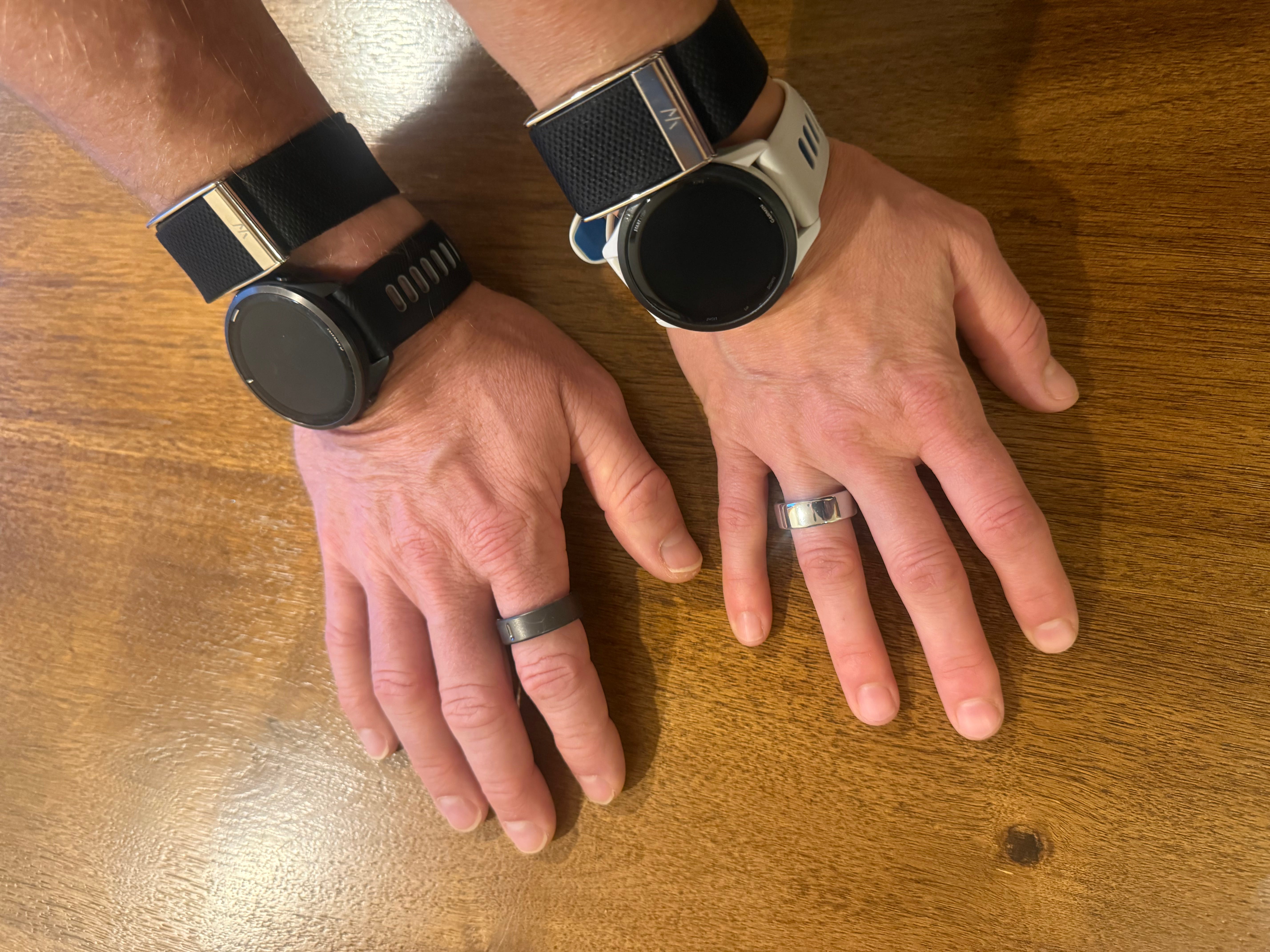
My wife Katie and I have been wearing a Garmin watch, an Oura Ring 4 and a Whoop MG every day since early July. We drew baseline labs. We underwent a DEXA scan, resting metabolic rate and submaximal lactate and VO₂ max testing. We tracked meals loosely, exercised normally, lived normally (which is not that normal in Alaska with all of our sunlight).
For the past 3-4 weeks, we just let the data sit there like most consumers do.
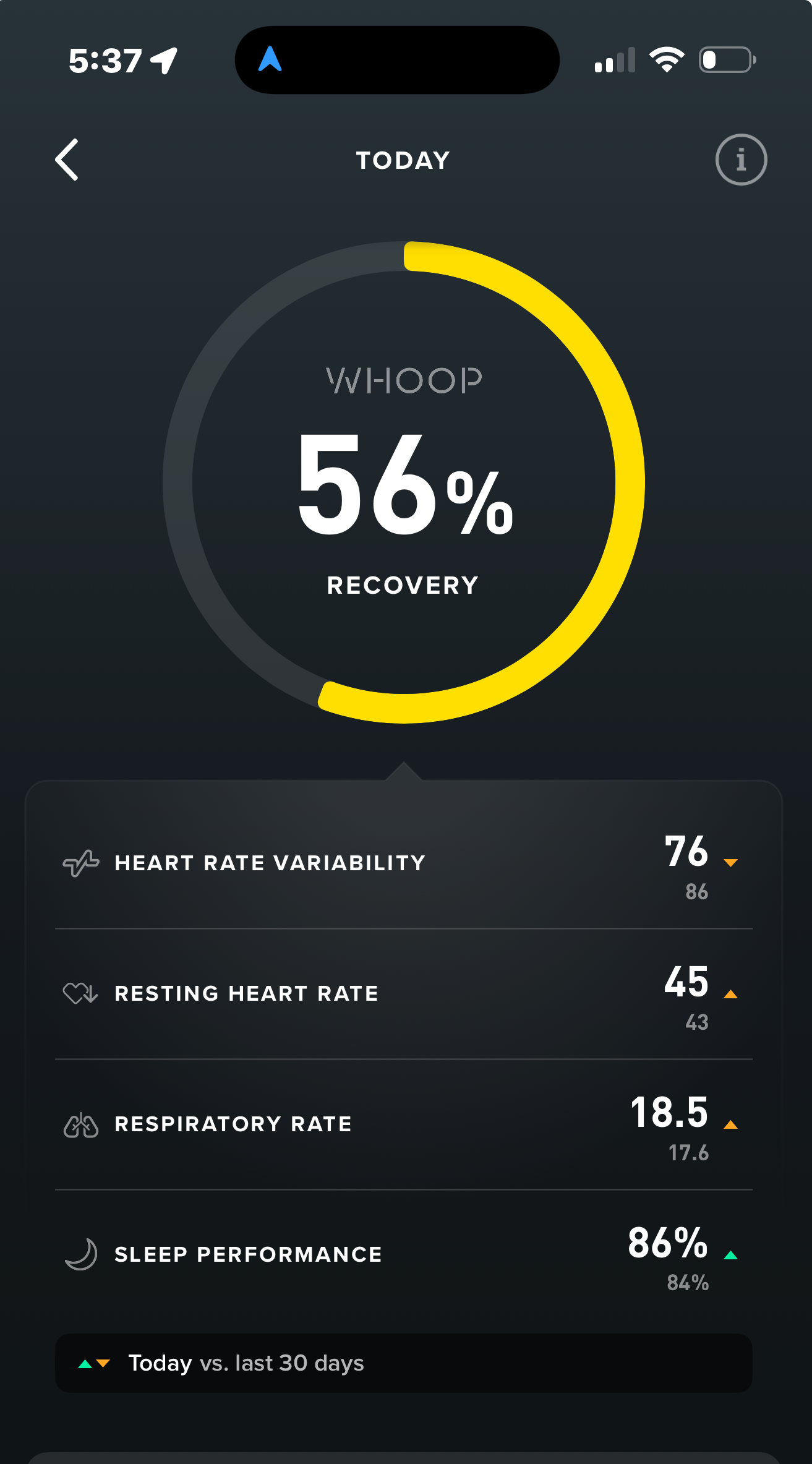
Our sleep scores were interesting. Our HRV trends were mildly informative. We checked the apps most mornings, nodded at the numbers, and went about our day. Nothing structurally changed. The devices were measuring us. We were not using the measurements.
Today we start the real experiment.
Day 1. 4 wearable devices, two guinea pigs, one scorecard.
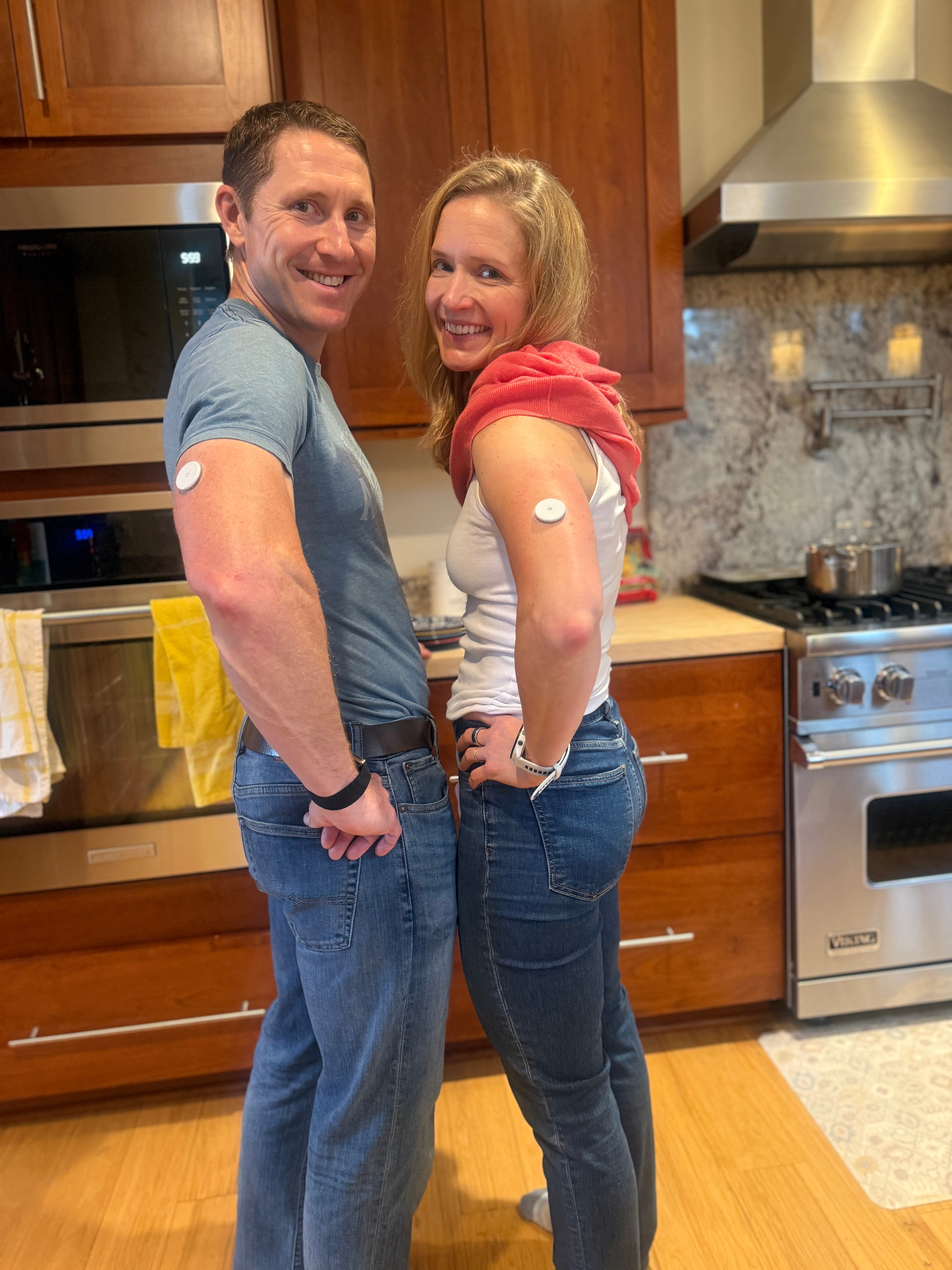
For the next 30 days, we’re adding two things. First, a continuous glucose monitor, the Abbott Lingo, for the first two weeks. Second, and most importantly, a structured daily journal. This is the same weekly scorecard I use with my patients. Every day we’ll log sleep quality, energy, stress, mood, soreness, motivation to train, macronutrient intake, training type and duration, weight, blood pressure, sauna and any alcohol. At the end of every week we’ll score ourselves across eight categories that I have tried to map to cardiovascular physiology.
I believe that the difference between wearing devices and changing behavior is using a framework.
Why use wearable devices to change behavior?
Up to 80 percent of cardiovascular disease is considered preventable. The variables that drive prevention are measurable, modifiable and mostly behavioral: what you eat, how you move, exercise and train, how you sleep, how you manage body composition and sometimes measuring, monitoring and attempting to change biomarkers that are associated with cardiovascular events.
Consumer wearables touch some of these variables: heart rate, heart rate variability, sleep duration, training load but miss many of these biomarkers that associate more strongly with cardiovascular disease: ApoB, Lp(a), blood pressure trajectory, fasting insulin, visceral fat.
Your wearable doesn’t know any of these biomakers.
I think what can be useful, insightful and eye-opening is under-appreciated; the value of a wearable was never supposed to be diagnostic. A ring is not a blood test. A watch is not a stress echocardiogram or a coronary CT. The question isn’t whether the devices are precise enough to diagnose disease. The question is whether a wearable device can help the user identify misaligned behaviors and change the behavior.
I’ll tell you when I had my aha! moment. Aches, pains and subtle brain fog set in sometime in my early 40s. A fascinating article in Nature Aging identified 2 time periods of more rapid aging (44 and 60) that provided some relative comfort to what I was experiencing. At the time, I was wearing my Garmin as I had for the past 2 decades but not in a structured or disciplined way. I decided I wanted to feel better. So I used wearable feedback, my sleep scores, HRV trends and an honest subjective assessment of how I felt each morning to first identify and then to break an almost daily drinking habit. I went from having a beer or 2 most days of the week to drinking seldom. My data didn’t make the decision. But the pattern and response to my behavior revealed worse sleep, lower HRV and brain fog in the morning on the days after I drank. This feedback made me recognize that my behaviors were causing me to feel how I did. This is not a clinical trial. It’s one person paying attention to his own trajectory. But I changed a behavior that years of knowing better had not changed.
Recent evidence suggests that werables might be able to change behavior, but only with structure. A 2026 review in the behavioral medicine literature found that hybrid interventions, a wearable paired with a structured framework, outperform wearable-only or app-only approaches for sustained physical activity. The devices provide awareness. The framework that is used can convert awareness into action. Without the framework, you get what researchers have called the “guidance infrastructure gap”: data without interpretation, trends without context, numbers without a plan.
The gap between casually observing wearable data and individually, personally associating behaviors with wearable data is what I’m trying to assess, teach and show in this series.
The population-level data on wearables is less encouraging. Broad deployment of wearable devices does not seem to meaningfully change outcomes across large groups. But if you focus in really sharply on the individual level, at the person who actually pairs their data with a specific framework and a willingness to change, the outcomes can be different. I’m writing this series to help that person.
The tools
Four wearable devices. Each one maps to a distinct physiologic domain. If the devices measure the same variable and several of them do, the overlap might be the lesson. Same trends, potentially different absolute number. The signal is in the slope.
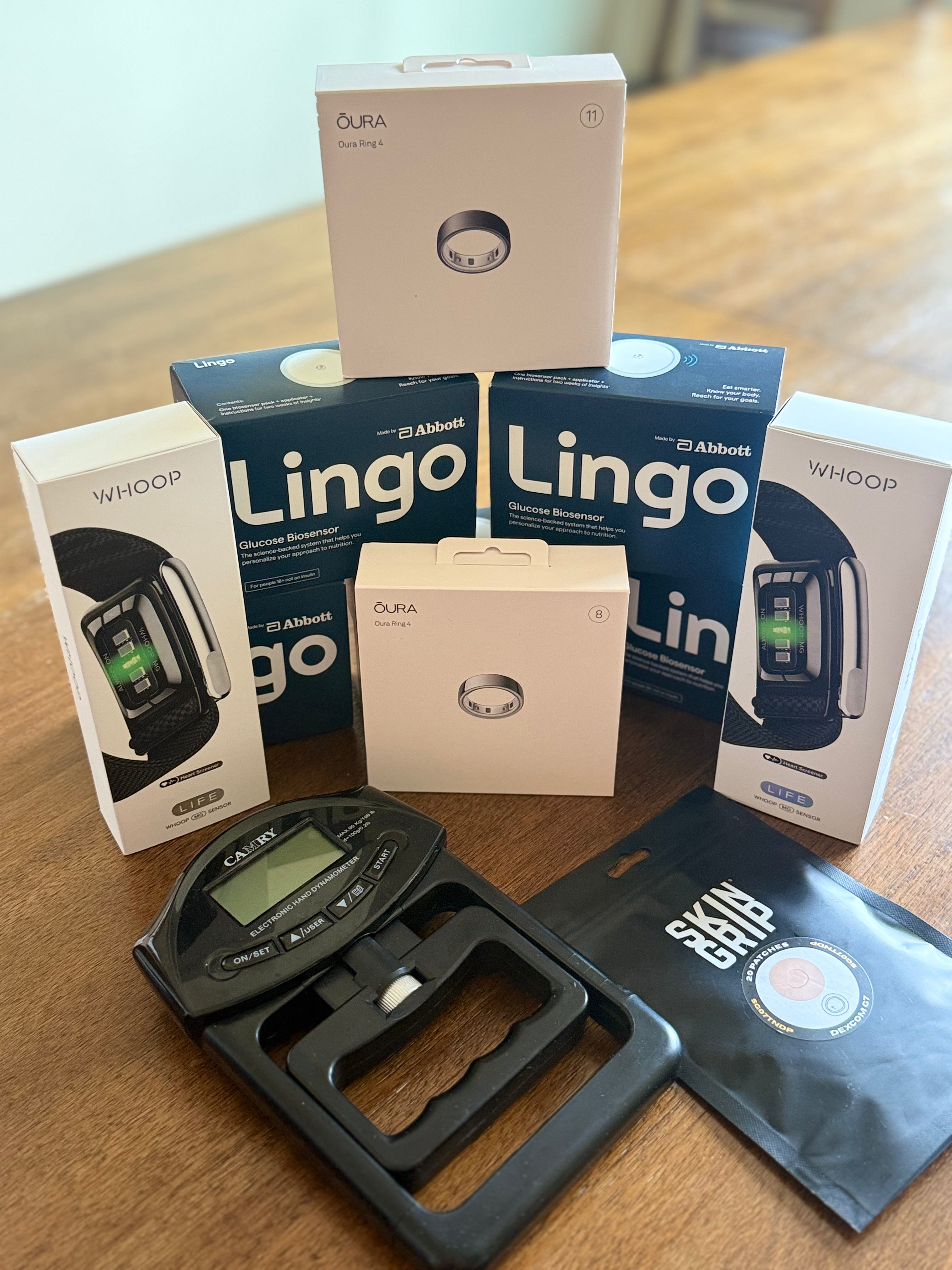
Garmin watch (Forerunner 965 for me, 265 for Katie). Heart rate, overnight HRV, sleep staging, VO₂ max estimate, training load, Body Battery. This is the primary training and cardiorespiratory fitness instrument. I chose Garmin over Apple Watch because Garmin is purpose-built for structured training: native Zone 2 and Zone 4 tracking, training load metrics and an ecosystem that connects directly to the scale. Also, full disclosure, I’ve used Garmin dating to the late 2000s.
Oura Ring 4. Finger-based HR and HRV (RMSSD), sleep staging, readiness score, temperature deviation. This is the primary sleep and autonomic recovery instrument. Is there overlap with the Garmin? Absolutely. This is part of the experiment.
Whoop MG. Strain, recovery, respiratory rate, HRV, ECG and an emerging blood pressure estimation feature that is currently under FDA regulatory review. Katie and I wear it on our wrists but it can also be worn on the bicep during exercise. Optical blood pressure estimation from the wrist is a promising technology but it is a poor substitute for a validated BP cuff. We use an Omron Evolv for blood pressure measurement, same arm, same time, every morning.
Abbott Lingo CGM. Continuous interstitial glucose for 14 days. Applied yesterday. We’ll wear it for the first two weeks of the experiment, then remove it. CGM teaches fast and plateaus by day 14 for non-diabetics. I’ll explain why in the series.
Garmin Index S2 scale. Daily weight. Same dashboard and App ecosystem as the watch. Weigh every morning, post-void, pre-food.
Katie tracks daily macronutrients with MacroTracker. I’m logging nutrition through Gemini and direct measurements.
A brief note on what we didn’t include: the Hume Band is an interesting emerging alternative at a lower price point, but it has a smaller validation track record and a proprietary “Metabolic Capacity” metric that was difficult for me to interpret clinically. I may revisit it and/or other of the myriad wearables at a future date.
The ground rules
All devices are self-purchased. No sponsorships. No affiliate links. This is stated plainly and will not change.
This is an n=2 experiment. Two adults, different physiology, same protocol, same instruments. Katie and I will attempt to identify and teach principles, not prove absolute physiology. Every article in this series will attempt to be grounded in published evidence. Our data makes the evidence tangible. It does not replace previous experiences and more clinically rigorous data.
Another interesting fact to share: Katie is 41, trains hard, and uses a Mirena IUD, which means she doesn’t have a predictable menstrual cycle to overlay on her wearable data. What Katie may have are the early, uneven hormonal shifts of perimenopause: disrupted sleep, increased soreness or changes in recovery that don’t follow a pattern the wearable algorithms expect. Most wearable data and content about female physiology focuses on cycle tracking. Katie’s reality is different here and it’s one that millions of women in their late 30s and 40s share. Her data will be interpreted in this context throughout the series. If this series does one useful thing, I’d like it to be this: showing that context matters more than any number or score.
The scorecard
This is the behavioral bridge between data and action.
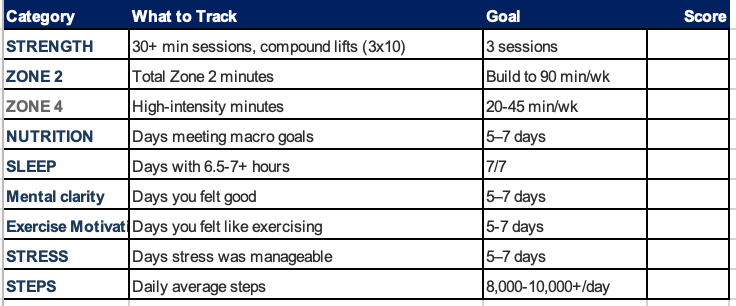
Every week, for both Katie and me, we’ll fill in the same card that I give my patients:
Strength: 30+ minute sessions, compound lifts. Goal: 3 per week.
Zone 2: Total Zone 2 minutes. Goal: build to 90 min/week.
Zone 4: High-intensity minutes. Goal: 0 until Zone 2 floor is met.
Nutrition: Days meeting macro goals. Goal: 5–7 days.
Sleep: Days with 7+ hours. Goal: 7/7.
Mental clarity: Days you felt good. Goal: 5–7.
Exercise motivation: Days you felt like exercising. Goal: 5-7.
Stress: Days stress was manageable. Goal: 5–7.
Steps: Daily average. Goal: 8,000+.
The scorecard doesn’t require a single device. It requires honesty with yourself and the data. The devices can sharpen the inputs: Zone 2 minutes need a heart rate monitor, sleep hours are easier to track with a ring or a watch. But the scorecard is the tool that turns passive measurement into weekly accountability.
Week 1. The card that turns data into action.
The question driving 30 days
Can consumer wearables, interpreted through clinical physiology and paired with a behavioral scorecard, change what we actually do?
Not what we know, what we track or which device is most accurate. What we do.
The critique is fair: the advice is the same regardless of the numbers. Eat well, sleep enough, exercise and manage your stress. True. The question is whether the numbers help you actually follow the advice. This is what we’re testing.
The goal of this series is not to determine which device is best. It’s not to convince you to wear four things on your wrist. My goal is to show you how these tools, used with structure, ideally with the guidance of a coach, trainer, or clinician, can help you monitor, track and improve the specific variables that matter for your health and life: cardiorespiratory fitness, body composition, sleep, quality of life.
These tools can be empowering. They can also be overpowering. I’m about to find out which, in real time, with my own data overload. I’ll try to carefully balance the subjective and the objective so that what I share with you makes your life a little simpler and potentially a little better.
Let’s go on a journey together.
Follow along
If you want to run a simplified version alongside us: pick one device, whatever you already own. Download the scorecard, log your macros and track for 30 days. I’ll review reader data in a follow-up post.
Download the Weekly Scorecard PDF
This series documents a personal experiment, not medical advice. Discuss any changes with your physician.
If this reframed how you think about your wearable, not as a gadget to obsess over but as a tool worth using right, send it to one person who’s been staring at their sleep score wondering what to do with it. Let’s replace the confusion with a framework.
Jake Kelly, MD, MHS, FACC is a board-certified performance and preventive cardiologist, Wasserman-certified in cardiopulmonary exercise testing, ACC Governor for Alaska, at Alaska Heart & Vascular Institute and founder of ROOL Health, a cardiometabolic longevity practice in Anchorage, AK and virtually in CO, FL, NC and TX. He practices where circulation, metabolism and cardiorespiratory fitness are treated as a single system. To learn more, work together, or get in touch, start at jakekellymd.com.
Medical disclaimer
This is general education, not medical advice. If you have questions about your wearable data, training, or cardiovascular risk, talk with your own clinician about what’s right for you.
The information provided here, including articles, newsletters, social-media posts, videos, and downloadable resources, is intended for general educational purposes only and does not constitute medical advice, diagnosis, or treatment. Your use of this content does not establish a physician-patient relationship with me or any contributor. Always seek the guidance of your own physician or another qualified health-care provider before beginning an exercise program, undergoing diagnostic testing, making lifestyle changes, or starting or stopping any medication or supplement. Never disregard professional medical advice or delay seeking care because of something you have read here. If you think you may have a medical emergency, call 911 (or your local emergency service) immediately.
Great to see a physician taking wearables seriously as valid health and fitness tools.
My current setup spans a few key devices: a Garmin Forerunner 970, Apple Watch, Whoop MG, Fitbit Air, and the Hilo Core for continuous 24/7 blood pressure monitoring (which was recently FDA-approved after being available in Europe since 2021).
I’ve also trialed Dexcom Stelo CGMs on a few occasions, but once I confirmed my baseline blood glucose was stable, I stopped wearing them. For me, it comes down to which metrics actually provide an actionable signal.
I find that using dynamic metrics rather than infrequent static measures provides me with the information needed to keep my health on track and continually work on maintaining my fitness.
NB: Wearables are imperfect. They often disagree with each other. The data is usually algorithm-based and hard to know the accuracy of the formulas. However, the devices are fairly reliable in establishing and monitoring trends.
Jacob, collecting more data only matters if it helps someone make a better decision. The structure that turns those numbers into consistent action is where the real value seems to be.