
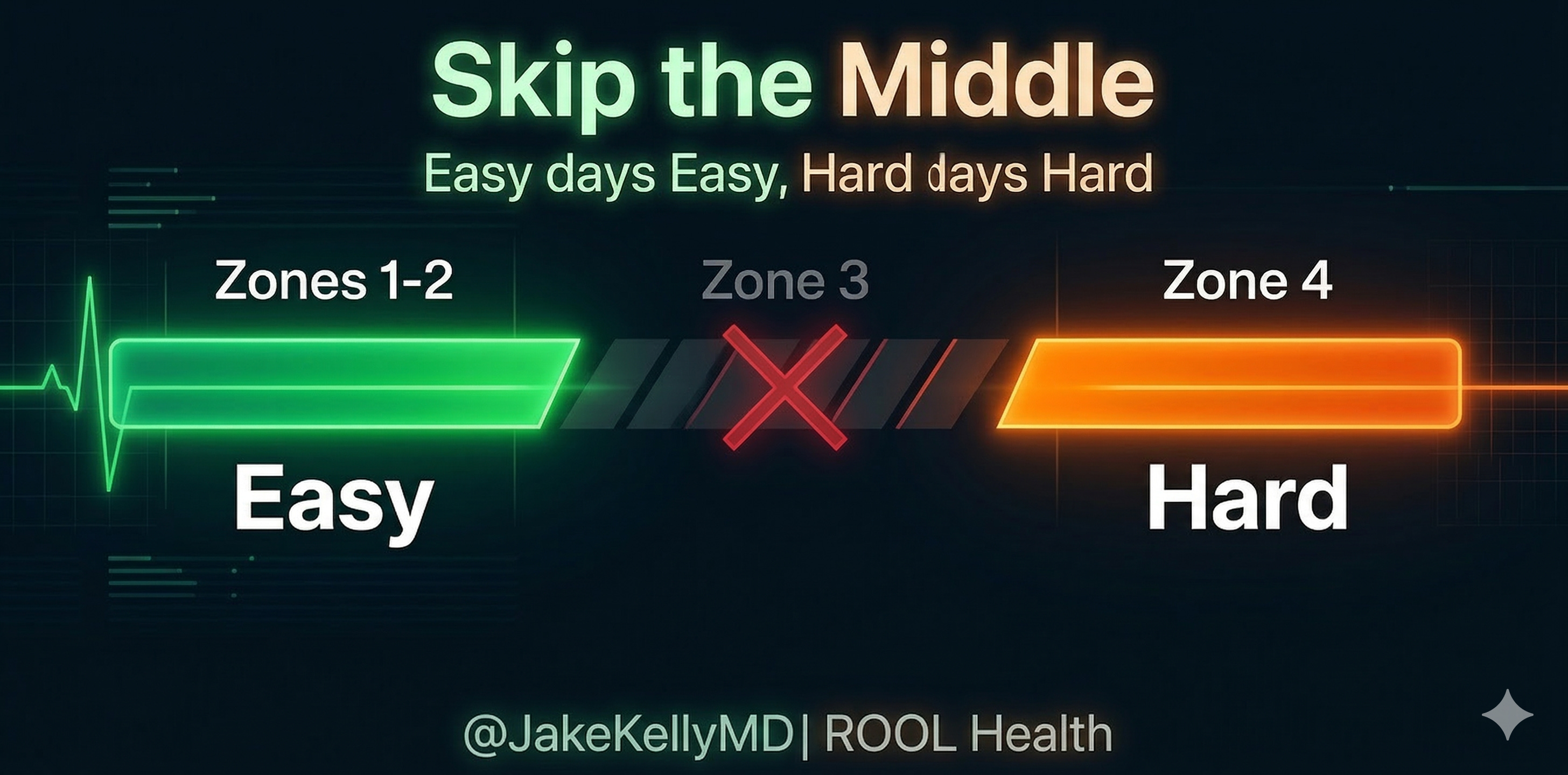
Skip the Middle
Easy days Easy, Hard days Hard

Jeff ran cross country in high school. District champion. State finalist. 29 years ago.
He’s 47 now. Five-eight, 225 pounds. Jeff hasn’t run a mile in two or three years. He sat across from me last week with a new Garmin 265 on his wrist, excited for the first time in nearly 3 decades about heart rate zones, HRV tracking & resting heart rate trends. He wanted to know which metrics were most important. Which protocol to follow? What was the next step?
I told him to slow down.
Data is fun. It matters. But everyone rushes to the shiny new gizmo (wearable), app or platform. Here’s the problem: they skip the foundation.
Last week I shared how to block three mornings and build a basic exercise week. The framework: 90 minutes, 3 hours, 6 hours answers how much. The calendar template answers when.
This week answers the next question I get from almost every patient:
How hard should I be going?
Most people get this wrong. It is not because they aren’t trying…it’s because they’re trying too hard. They lace up their shoes, start running and settle into a pace that feels productive. Breathing hard. Heart-pounding. Sweating. The effort feels like real work. It feels like Zone 2.
It’s not. It’s almost certainly Zone 3.
And Zone 3 is the zone we’re going to skip.
The Problem with Zone 3
Zone 3 isn’t dangerous. It’s just inefficient. You’re working hard enough to accumulate real fatigue, which takes 24-48 hours to recover from. But the effort is not hard enough to meaningfully raise your cardiorespiratory fitness ceiling (VO₂ max). You’re also working too intensely to build the aerobic base that Zone 1 and Zone 2 are designed to develop.
Zone 3 is the middle ground that delivers the least return for the effort invested.
Most people who feel they train in Zone 2 are actually in Zone 3. They feel like they’re not working hard enough at a true Zone 2 heart rate, so they push just a little harder. This push crosses the line of efficiency. This is why they always feel tired but don’t realize gains in speed, strength or body composition.
Here’s the framework I use with my patients. Four zones to train in. One to avoid.
Zone 0: Move More, Sit Less
This isn’t training. It’s the foundation underneath training.
Zone 0 is everything you do outside of structured exercise. Standing instead of sitting. Walking between patients (or during your kids sporting events). Taking the stairs. Parking farther away. Playing with your kids on the floor. Carrying groceries instead of using a cart.
The research on non-exercise activity thermogenesis (NEAT) is compelling. The difference in daily energy expenditure between a sedentary office worker and an active one can be 500-700 calories. That’s not trivial. Over months and years, it compounds into meaningful metabolic health (1 pound of weight loss vs. 1 pound of weight gain per week).
Jeff’s Garmin tells him he’s averaging 6,000-7,000 steps a day. That’s not unusual for someone with a desk job. Our first goal isn’t a running program. It’s 10,000 steps. That means roughly 30-40 minutes of additional walking woven into his day. This is achieved with a morning walk with the dog, parking at the far end of the lot and taking calls on his feet. This is about two and a half hours of total movement throughout the day. No special gear. No heart rate target. Just move more.
I notice this myself. Days I’m in clinic walking between rooms, I feel different than days I’m at a desk writing notes for four hours. My flexibility declines. My hamstrings & glutes tighten. My energy drops. The structured morning workout does not fully offset eight hours of sitting.
Zone 0 prescription: Reduce prolonged sitting. Stand or walk for 5 minutes every 30-60 minutes. Walk when you can. Take calls on your feet. This is the floor beneath the floor. For Jeff, the Garmin step counter is the only metric that matters right now. Get to 10,000. Then we talk about Zone 1.
Zone 1: The Zone You Can Do Forever
Zone 1 is where I want most people spending most of their training time.
I know that’s a contrarian take. Zone 2 gets all the attention: every fitness influencer has a Zone 2 protocol. Zone 2 is valuable. Here’s what I’ve come to believe after twenty years in cardiology and endurance sport:
If you start in Zone 1, you’ll naturally progress into Zone 2 as you warm up and extend the session. You’ll build the aerobic system… capillary density, mitochondrial efficiency & fat oxidation without the fatigue cost that comes from pushing into Zone 3.
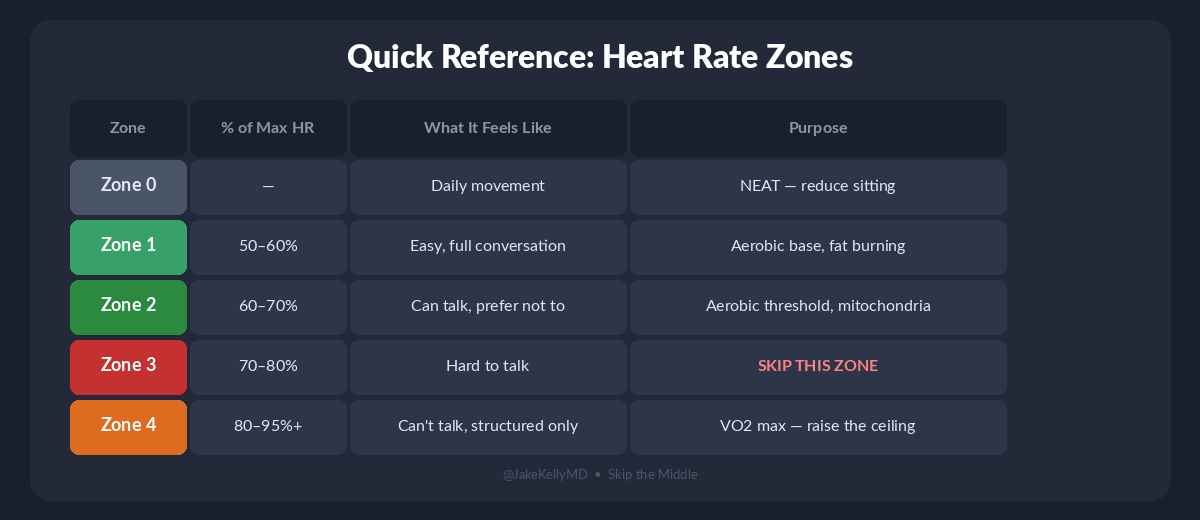
Zone 1 is approximately 50-60% of your maximum heart rate. For most people, this means a heart rate in the 100-120 range. It should feel easy. You should be able to hold a full conversation without pausing for breath. You might feel like you’re not working hard enough.
That easy feeling is the point.
What Zone 1 builds:
Capillarization: more blood vessels feeding your muscles
Mitochondrial density: more cellular powerhouses burning fuel
Fat oxidation: teaching your body to use fat as its primary fuel source
Aerobic base: the foundation cardiorespiratory fitness & physiologic reserve is built on
Recovery between harder sessions
What Zone 1 doesn’t tax:
Your nervous system
Your joints
Your sleep
Your ability to show up again tomorrow
The best training program is the one you can do every day without dreading it. Zone 1 is that program.
For Jeff, Zone 1 means lacing up and walking fast enough that his heart rate stays between 87 and 104. His estimated max heart rate: 220 minus 47 = 173. Fifty to sixty percent of that is roughly 87-104. On his Garmin, that’s the green zone. He’ll feel like he’s barely working. That’s the point. After 29 years away from competitive running, his aerobic base needs to be rebuilt from the ground up. Zone 1 is where this happens.
Zone 1 prescription: 30-60 minutes, 3-5 days per week. Walk, hike, easy bike, easy swim. Heart rate 50-60% of max. Conversation pace. This is where you live.
Zone 2: The Aerobic Threshold
Zone 2 is where your body is working at the upper edge of aerobic metabolism: lactate is present but stable, hovering around 1.5-2.0 mmol/L without further rise. You’re at the maximum sustainable intensity where fat is still a primary fuel source. This is the zone everyone talks about.
But most people overshoot it.
Zone 2 is approximately 60-70% of your maximum heart rate. The breathing test is useful: you can talk, but you’d rather not. Full sentences are possible but you notice your breathing between them. If you’re gasping or breaking sentences to inhale, you’ve crossed into Zone 3.
Finding Your Zone 2 Without a Lab
The Maffetone method is simple: 180 minus your age. That number is your approximate Zone 2 ceiling.
Jeff is 47. His Maffetone ceiling: 133. That means any time his Garmin shows a heart rate above 133, he’s crossed out of Zone 2 and into Zone 3. For a former cross-country runner who remembers running 5:20 miles, jogging at a 133 heart rate is going to feel painfully slow. It might be a 12- or 13-minute mile. Or brisk walking. That’s fine. That’s the work.
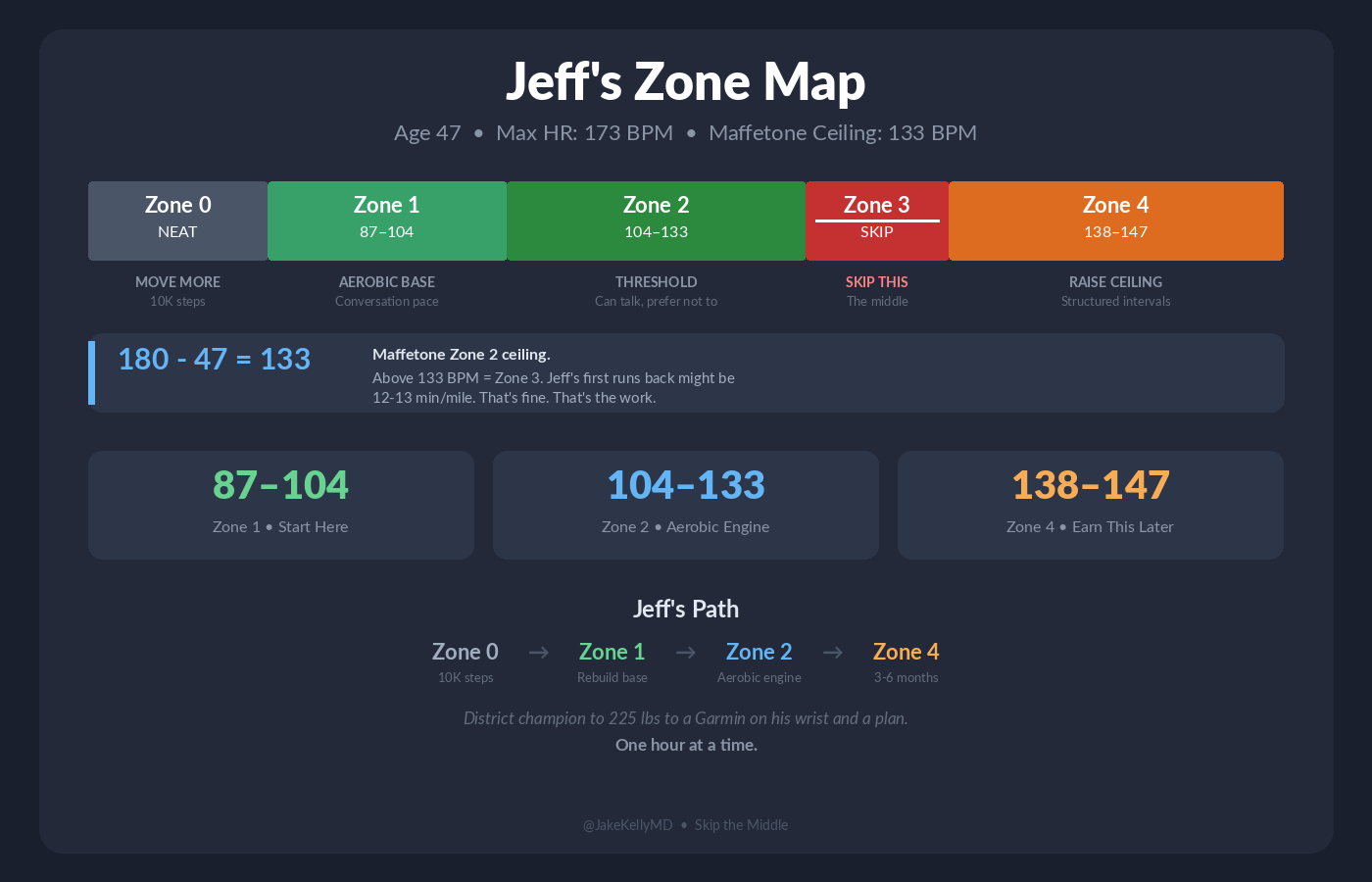
I’m 45. My ceiling: 135. Almost identical to Jeff’s… just two years younger.
My actual lactate testing confirms: 130-135 on the bike, 140-145 running. The difference between modalities is real and worth knowing. Your heart rate zones are not identical on a bike, a treadmill or in the pool. Running typically runs 5-10 beats higher than cycling at equivalent effort because of the weight-bearing component.
The Maffetone formula isn’t perfect. But it’s free, requires no equipment and gets you 90% of the way there. If you want precision, a VO₂ max test with or sub-maximal lactate testing will give you exact thresholds. But don’t let the perfect be the enemy of starting.
The hardest part of Zone 2: You’ll be shocked how slow you have to go at first. That’s normal. That’s the point. If you’ve been training in Zone 3 for years, your aerobic base is underdeveloped relative to your fitness. Slowing down to Zone 2 will feel like going backward. It isn’t. You’re rebuilding the engine from the foundation up.
Gordo Byrn, whose book Going Long shaped how I think about training structure and whose updated From Lemon to Legend, I recommend to anyone serious about endurance captures the details perfectly. Slow down to push it up. Teach your body efficiency at low intensity and the ceiling rises over months.
Zone 2 prescription: 1-3 sessions per week within your Zone 1-2 training. As your session extends past 20-30 minutes, let your heart rate naturally climb from Zone 1 into Zone 2. Aim to accumulate 20-45 minutes of Zone 2 per session. Don’t force it. Don’t chase it. Let it find you as the workout progresses.
Zone 3: The Last Zone to Add
I’m not saying Zone 3 is useless. I’m saying it’s the least efficient place to start and it’s where most people live by default.
Zone 3 is approximately 70-80% of max heart rate. It feels like real work. You’re breathing hard. You can’t hold a conversation comfortably. You feel like you’re training.
But physiologically, it’s a middle ground. Too intense to build the aerobic base that Zones 1-2 develop. Yet, it is not intense enough to stimulate the VO₂ max adaptations that Zone 4 delivers. The fatigue-to-adaptation ratio is poor for most people.
Gordo Byrn calls this the Tempo or Heavy Domain in his Substack Endurance Essentials and he’s right that it has a role. Tempo work trains intermediate muscle fibers and builds the kind of sustained-effort capacity that endurance athletes need. I use moderate tempo work with patients who have a solid aerobic base and specific performance goals.
Here’s the problem: most recreational exercisers live in Zone 3 by default without ever having built a Green Zone foundation. It’s the natural pace your body gravitates toward when you’re “working out” without a heart rate target. This is why so many people feel tired all the time (from working out) but aren’t getting faster, stronger or leaner.
Build your Green Zone first. Add Zone 4 intervals. Then, once your aerobic foundation is solid and you want to push your sustained effort tempo has a place. It’s the last zone to add, not the first to train.
Zone 3 guidance: If you find yourself here during a Zone 2 session, slow down. If you find yourself here during a Zone 4 session, push harder or rest. If you’ve been training for 6+ months with a strong aerobic base, one tempo session per week can sharpen your intermediate gears. Earn it first.
Zone 4: Raise the Ceiling
Zone 4 and beyond is everything above lactate threshold through VO₂ max or approximately 80-95%+ of your maximum heart rate. This is where you raise the ceiling of your aerobic capacity. This is where the mortality data gets dramatic.
Every 1-MET increase in aerobic capacity equals roughly a 12% reduction in all-cause mortality. Zone 4 training is how you top off those METs but you’ll only see significant improves if you have a solid Zone 1/2 base to build upon.
But it requires structure. Going hard without a plan is Zone 3 in disguise. Structured intervals with complete recovery are the key.
The Honest Truth About 4×4s
The most studied high-intensity protocol is the 4×4 Norwegian interval. Four minutes at 90-95% max heart rate, 3-4 minutes recovery, repeat four times. The research behind it is excellent. The problem? For most of my patients and honestly, for me, four straight minutes at 90%+ is brutal. It’s the kind of workout that makes people dread Tuesday. When you dread the workout, you skip it.
This defeats the purpose.
What the Pros Are Actually Doing
Here’s what I find more interesting and more sustainable. WorldTour cycling teams such as Visma-Lease a Bike, INEOS Grenadiers and others have moved toward variable-length intervals designed to accumulate more total time at VO₂ max without the psychological grind of four-minute blocks. Much of this is built on Bent Rønnestad’s research out of Norway. The structure looks something like this:
Peloton-Style VO₂ Blocks: 1 minute on, 1 minute off 2 minutes on, 1 minute off 2-3 minutes on, 1 minute off, 1 minute on, 1 minute off
Rest 3-5 minutes. Repeat 2-3 times.
The goal isn’t to survive one heroic 4-6 minute interval. It’s to accumulate 12-16 minutes of total time at or near VO₂ max across the session. The shorter efforts at the start let you settle in. The longer middle efforts do the real work. The final short effort is a controlled finish, not a death march.
Why does this work? Because the recovery periods are short enough that your oxygen consumption stays elevated. You’re spending more total time in the physiological zone that matters: near VO₂ max, without the mental torture of staring down four consecutive minutes at 93% heart rate.
Other Protocols Worth Knowing
30/30 Protocol Find your velocity at VO₂ max through a 6-10 minute all-out effort (roughly your fastest sustainable pace for that duration). Run at 100% of that velocity for 30 seconds, then 50% for 30 seconds. Start with 10 repetitions. Build to 20-30 over weeks. Same principle: accumulate VO₂ exercise time through shorter, repeatable efforts.
Build Intervals 90 seconds hard, 90 seconds recovery. Then 2 minutes hard, 2 minutes recovery. Then 3 minutes, then 4 minutes. Full recovery between sets. Accumulate 15-20 minutes of total hard effort.
The Common Thread
Notice what all of these share: the goal is total accumulated time at high intensity, not surviving one punishing block. Twelve to sixteen minutes of VO₂-level effort in a session. That’s the target for most of us. How you get there matters less than getting there consistently, week after week.
How Often
Once per week. That’s it. If you’re over 40, even once every 7-10 days delivers significant benefit. If you’re recovering well and under 40, you could add a second session. But one is enough.
The total session: 15-20 minute warm-up → 15-25 minutes of interval work → 10 minute cooldown. A 45-60 minute workout that moves the needle more than two hours of Zone 3.
For someone like Jeff: deconditioned, coming back after years away, Zone 4 doesn’t mean 90-95% of max. It means 80-85%. For Jeff, that’s roughly 138-147 on his Garmin. And he’s not starting here. Zone 4 is where Jeff can end up in three to six months, after he’s built his Green Zone foundation. Not in week one. Not month one. Build your green zone (Zone 1/2). Earn don’t rush Zone 4.
Zone 4 prescription: One structured interval session per week. Pick a protocol you’ll actually do. Recover fully between effort. Don’t turn your session into a Zone 3 sufferfest. The best interval protocol is the one you show up for.
Why Heart Rate Matters More Than Pace
Pace is an outcome. Heart rate is the input.
Your pace at Zone 2 will change based on sleep, hydration, stress, altitude, temperature, whether you’re on a bike or running and a hundred other variables. A 9:30 mile might be Zone 2 on Monday and Zone 3 on Thursday after a bad night of sleep.
Heart rate doesn’t lie. It tells you what your body is actually doing, not what your ego thinks it should be doing.
A chest strap or arm band heart rate monitor (Polar, Garmin, Coros) is more accurate than wrist-based optical sensors, especially during intervals. If you’re serious about training by zone, invest in one. It’s the cost of two weeks of coffee.
Quick Reference: Finding Your Zones
Step 1: Estimate your max heart rate. The simplest formula: 220 minus your age. (It’s imperfect, but it’s a starting point.)
Step 2: Apply percentages.
Step 3: For a more personalized Zone 2 ceiling, use Maffetone: 180 minus your age.
Step 4: Wear a heart rate monitor. Train by heart rate, not pace.
Putting It Together
If you built your basic week last Tuesday, here’s how intensity layers in:
The 3-hour week:
2 sessions Zone 1-2 (aerobic base)
1 session strength
Weekend long effort Zone 1 with natural Zone 2 drift
The 6-hour week:
2-3 sessions Zone 1-2
1 session Zone 4 intervals
2-3 sessions strength
Weekend long effort Zone 1-2
Every week, all the time:
Zone 0: move more throughout the day, every day
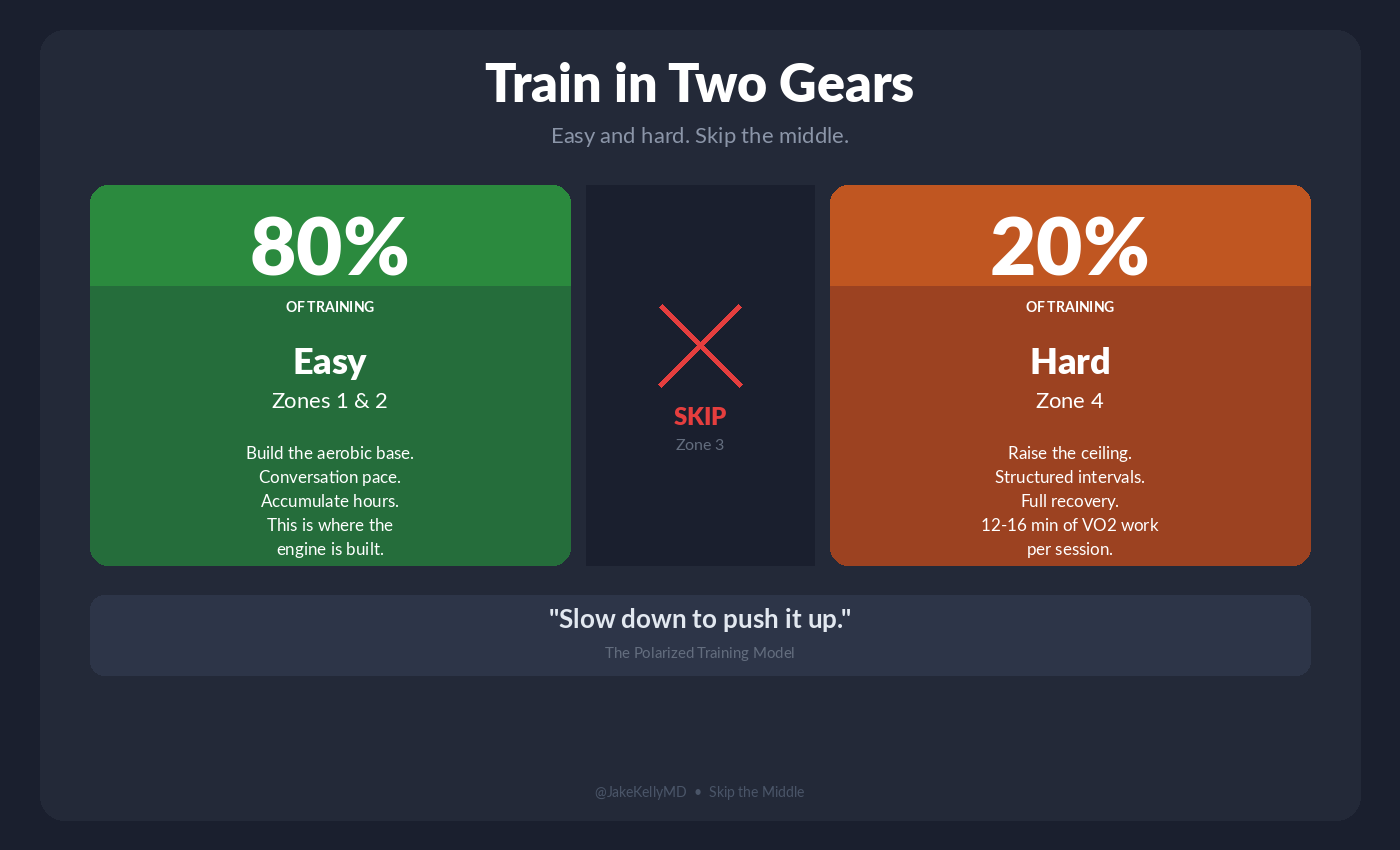
The ratio most people need: roughly 80% of your aerobic training in Zones 1-2 and 20% in Zone 4. This is the polarized training model and the evidence supports it across ages and fitness levels. The middle, Zone 3, is where most recreational athletes spend their time and it’s the least productive place to be.
Think in Hours, Not Weeks
Here’s the reframe I give my patients each week in clinic: stop thinking in days. Stop thinking in weeks. Start thinking in cumulative hours.
Can you get to 50 hours of Zone 1-2 training? Can you get to 100?
Cumulative hours moves the needle. Not one great week or one perfect month. The compounding of aerobic hours: session after session, month after month is what drives your HRV up, lowers your resting heart rate and drives your cardiorespiratory fitness higher. This is how you build physiologic reserve.
Fifty hours of Zone 1-2. Then a hundred. Then two hundred. Each hour stacks on the last. Your mitochondria don’t care whether it happened on a Monday or a Saturday. They care that the hours accumulated.
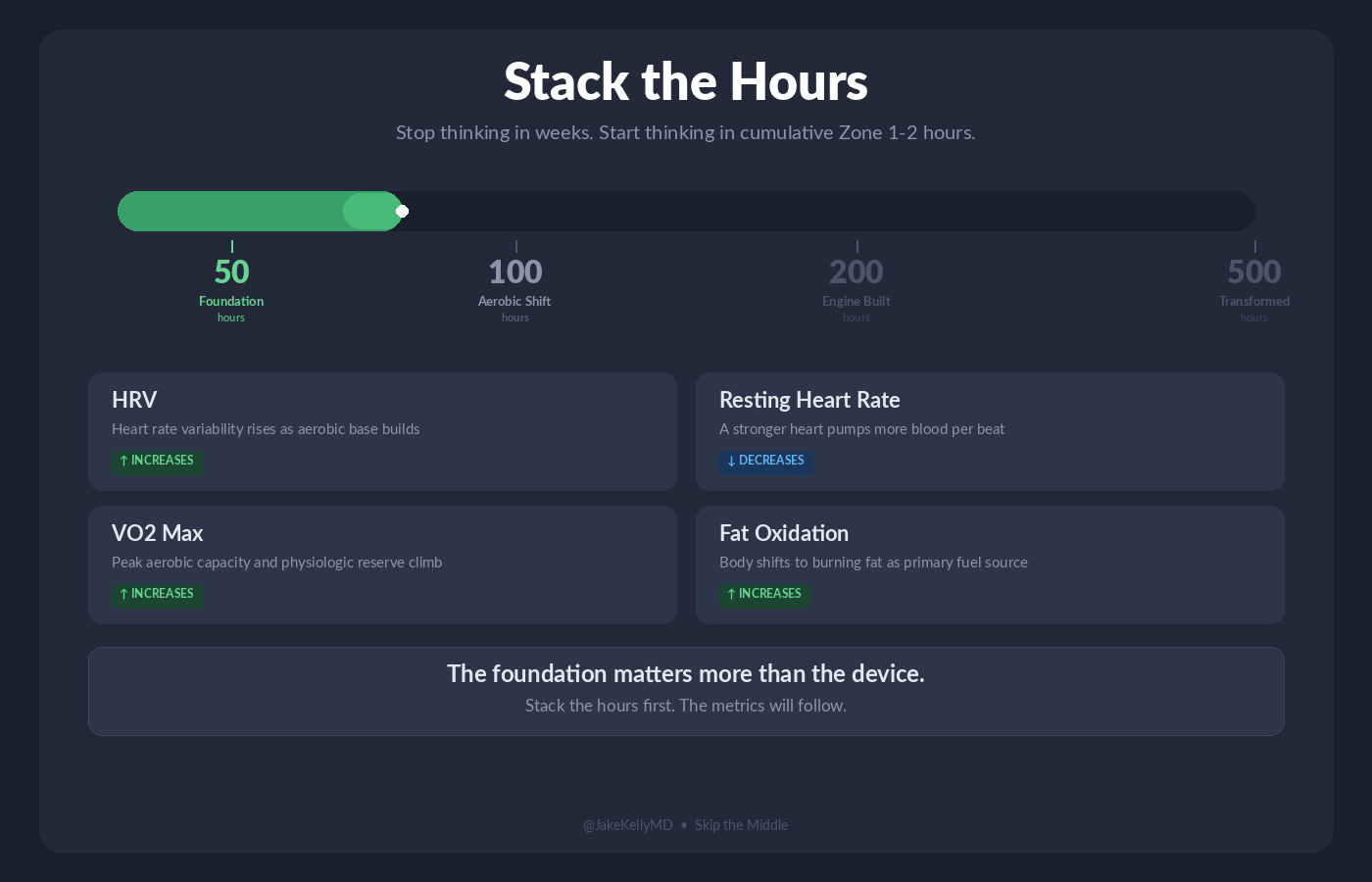
Jeff doesn’t need a new app. He didn’t need a fancier watch. He needs 50 hours of Zone 1-2 on his legs. Then 100. The Garmin 265 will track every one of them (as long as he does them). This is the foundation of fitness. Of Health. Not the device. Or the protocol. The hours.
Stack the hours. Build your base. Your health metrics will follow.
The Mantra
Slow down to push it up.
Slow down your easy days. Build the aerobic base. Teach your body to burn fat efficiently. Then, once a week, go hard with structure and full recovery. This contrast: easy days genuinely easy, hard days genuinely hard is what builds the engine.
Most people train in one gear: moderate. And moderate is Zone 3.
Train in two gears instead. Easy and hard. Skip the middle.
Your heart rate will keep you honest.
Jeff’s will too. District champion to 225 pounds to a Garmin on his wrist and a plan. Zone 0 first. Then Zone 1. Zone 2. Eventually Zone 4. One hour at a time.
Keep stacking.
—Jake
Next week: ApoB : The Number That Matters Most. We’re pivoting from how your body moves to what’s flowing through your blood vessels. The Circulation side of the Triangle.
Questions? Drop them in the comments. I read every one.
References
Myers J, et al. Exercise Capacity and Mortality Among Men Referred for Exercise Testing. NEJM. 2002;346(11):793-801.
Kodama S, et al. Cardiorespiratory Fitness as a Quantitative Predictor of All-Cause Mortality and Cardiovascular Events. JAMA. 2009;301(19):2024-2035.
Helgerud J, et al. Aerobic High-Intensity Intervals Improve VO₂ max More Than Moderate Training. Med Sci Sports Exerc. 2007;39(4):665-671.
Seiler S, Tønnessen E. Intervals, Thresholds, and Long Slow Distance: The Role of Intensity and Duration in Endurance Training. Sportscience. 2009;13:32-53.
Maffetone P, Laursen PB. Athletes: Fit but Unhealthy? Sports Med Open. 2016;2(1):24.
Rønnestad BR, et al. Short Intervals Induce Superior Training Adaptations Compared with Long Intervals in Cyclists. Scand J Med Sci Sports. 2015;25(2):143-151.
Levine JA, et al. Interindividual Variation in Posture Allocation: Possible Role in Human Obesity. Science. 2005;307(5709):584-586.
Billat LV. Interval Training for Performance: A Scientific and Empirical Practice. Sports Med. 2001;31(1):13-31.
These rules of thumb can really be off. I am 70 this year, which would imply a max heart rate of 150 and a zone 2 ceiling using your formula of 110. I can hit mid 170s in a hard workout, I figure my max is around 185. Had a Vo2max test (50.2) and the top of my zone 2 is 143 according to the results. Try to keep my pure z2 workouts below 130, but that is still 20 higher than the formula.
Any thoughts for patient's on beta blockers? Wait to take after exercise, ignore, ??
Great article though. I've shared with many friends and family.