
Three Things I Can Remember
Memory, motion and the shape of health


My clearest thinking still happens the same way it did when I was a teenager.
Driving. Hands on the wheel. Singing a song half outloud that only I can hear, while the road stretches forward just enough to keep my body occupied while my mind loosens.
Music helps.
Looking back to my most impressionable years (middle school and high school), the songs I listened to then still bring emotion and clarity. Van Halen, blasting before soccer games. Pure energy. Momentum. Confidence.
One lyric still floats back to me:
“Might as well jump.”
It’s not nostalgia. It’s pattern recognition. Movement quiets noise. Repetition brings clarity. When enough distractions fall away, the same ideas keep resurfacing.
I’ve learned to trust those moments.
I’ve been journaling consistently since November 2024. I started sharing those thoughts publicly last July, on my 45th birthday.
Looking back, now that I’m including more deep conversation in my personal and clinical practice, that timing wasn’t accidental.
Midlife has had a way of stripping away excess fluff and filler from my mind, forcing me to ask deeper, sharper questions:
What do I actually want to do and be remembered for with my remaining half (or less?) of my life?
What do I really believe about health? What moves the needle, what has worked in the over 50,000 patient encounters I’ve have in my career thus far?
What works, consistently, over decades for me, my patients and my family?
I wake up every day and I ask myself, do I still love taking care of patients? Yes, deeply. I love to be involved, I love to help. I love to have the answer. When I look inward, deeply, I realize that I most enjoy sharing my knowledge and when I look and don’t have the answer, I now can comfortably say that I don’t… but then I will derive satisfaction from the unanswerable question and then inquisitively go about helping to find the answer.
I love being a medical home, a steady presence, for people in my community.
I have come to love talking about how to insert (more?) healthy activities into busy daily lives through walking breaks at work, better food choices, improving sleep through various physiological and psychological techniques, assess mood, family and life purpose. I love using medications when they’re needed but I no longer want to pretend medications are the whole or even majority of the clinical story.
I’ve grown more honest with myself and the medical community about something that’s been bothering me for a long time.
We measure a lot in medicine.
We just don’t measure the right things early enough nor do we repeat the key measurements to understand a patient’s health and life trajectory.
Here’s something else I’ve learned about myself and about my patients:
I can’t remember ten things.
On a good day, I can remember three.
Most of the people I care for are the same.
Medicine and technology today overwhelm patients with dashboards, portals, lab panels and advice that’s technically correct but practically unusable. We ask patients to track dozens of variables but we don’t always give actionable advice for the changes. We then wonder why nothing changes.
But long before modern medicine, people understood something we’ve lost.
The number three matters symbolically, spiritually and resonates with people at our deeper core.
The Egyptians revered the triangle.
Pythagoras formalized it. I still remember this formula I first learned in 7th grade.
The Pythagorean theorem is simple:
a² + b² = c²
Three sides.
One relationship.
Perfect stability.
Three points define a plane.
Three pillars create structure.
Three is about all most of us can carry in my busy brains, especially when life gets busy, stressful or overwhelming.
So this year, I’m organizing my thinking and my writing around a triangle.
Not because it’s clever.
Because it’s memorable.
A triangle will hold under pressure.
When I strip health down to first principles1, I keep landing in the same place.
If I ask:
What shortens life and independence?
What reliably leads to hospitalization, disability and suffering?
What quietly compounds, for better or worse, over decades?
The answers converge.
The Triangle
The three pillars I keep returning to are:
Fitness.
Metabolism.
Circulation.
That’s it.
Underneath those simple words live the clinical details, but the structure stays clean.
Fitness
Cardiorespiratory fitness. VO₂ max. The ability to move oxygen and do physical work.
This is physiologic reserve. Margin of safety. The cushion that lets people withstand illness, surgery, stress and aging without breaking.
Metabolism
Insulin sensitivity. Waist circumference. Triglycerides. Muscle. This is fuel handling. Metabolic flexibility. The difference between quiet stability and slow drift toward diabetes, cancer risk and cognitive decline.
Circulation
Atherogenic particles. Blood pressure. Vascular health. This is delivery. Blood to brain, heart, and muscle… year after year. It’s stroke prevention. Dementia prevention. Heart failure prevention.
If these three pillars are strong, most downstream disease becomes far less likely.
Not eliminated. But delayed. Softened. Often avoided.
Years of caring for patients with complex medical, cardiology and heart failure conditions have taught me something humbling.
The end of the story is usually written decades earlier.
Not by a single catastrophic event. But by predictable decline we didn’t measure, didn’t prioritize or didn’t think mattered yet.
Fitness quietly falls.
Insulin quietly rises.
Blood pressure drifts upward.
Unhealthy levels of atherogenic particles accumulate.
We’re very good at reacting once disease declares itself.
We’re much less skilled at preventing the drift from wellness to almost sickness.
This year, I want to change how I think and how I teach about prevention. This may change but I’m starting with a framework.
Each month, I’ll plan to rotate through the three sides of the triangle:
One week focused on Fitness
One week on Metabolism
One week on Circulation
And the fourth week, I’ll take a break or I’ll share something I’ll writing about personally… on patients, family, purpose, failure, or the lessons that don’t fit neatly into charts and graphs
Sometimes the writing will be clinical.
Sometimes personal.
Often both.
Because health isn’t just numbers.
And it’s never just biology.
Some of my best insights still come while driving.
Music on.
Body moving forward.
I think about the music my parents played in the car; songs about commitment, patience, and staying power.
“Forever and ever, amen.”
I reflect about my kids watching how I live and work.
I remember patients who taught me that strength, resilience and independence matter far more than perfect labs as life erupts its ugly head.
I don’t believe health needs to be complicated.
I believe it needs to be remembered.
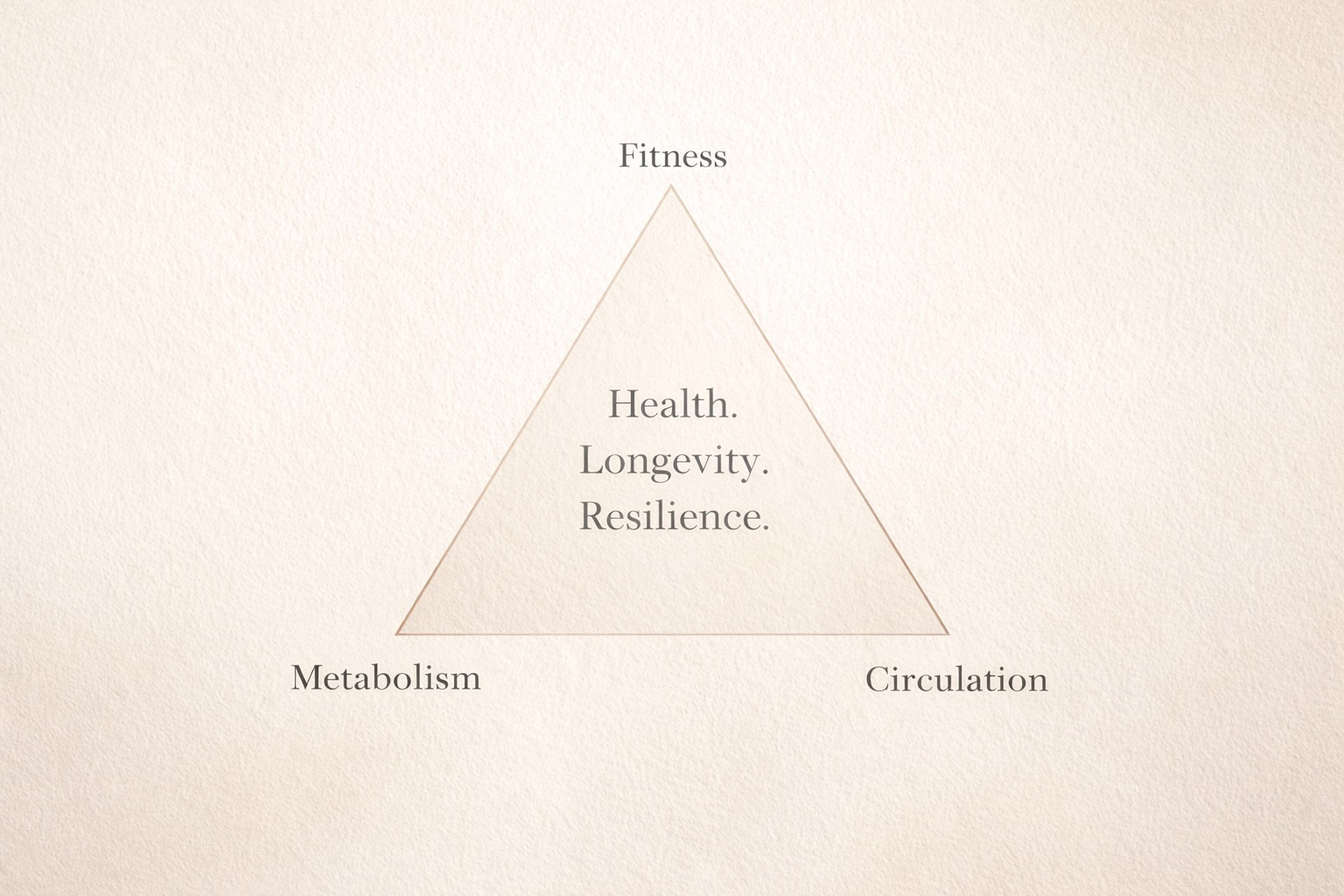
Three things.
Held lightly.
Revisited often.
This is the shape I’ll keep returning to again and again as the year unfolds.
Thanks for being here for the ride.
— Jake
Much of my thinking around simplification, first principles, inversion, and building margin of safety has been shaped by the work of Shane Parrish, particularly The Great Mental Models, Volume 1 & 2 and Clear Thinking. These books explore how enduring principles from mathematics, physics, and human behavior can help us make better decisions in complex systems, including in health.
Love this framework and the humility behind it! As clinicians we can measure everything, but most patients can reliably act on only a few things. The “triangle” is a smart way to turn prevention from an overwhelming dashboard into something memorable and durable.
What I especially appreciate:
1. Fitness = physiologic reserve. VO₂/strength aren’t just performance metrics, but they’re your buffer against illness, surgery, and aging-related shocks.
2. Metabolism = fuel handling. Waist, insulin resistance, triglycerides, muscle mass; this is the slow drift that often precedes “diagnoses” by years.
3. Circulation = lifetime exposure. BP + atherogenic particle burden (ApoB/LDL) quietly compound until the first event makes it “real”.
And the line about the end of the story being written decades earlier is painfully true. Most of what we call “sudden” (MI, stroke, heart failure) is usually the predictable result of trends we didn’t track early enough or didn’t simplify enough to change.
Excited to follow this series. A prevention framework that people can remember is often the one that actually works!
HRT for your female patients underlies all three. The evidence is there - but the profession needs to get up to speed and shake off the damage done by the WHI. It affects 50% of the population. All practioners need to get on board. It's not a gynocology issue. It's circulation, BONES, BRAIN, insulin resistance with lifestyle improvement, system wide!!